
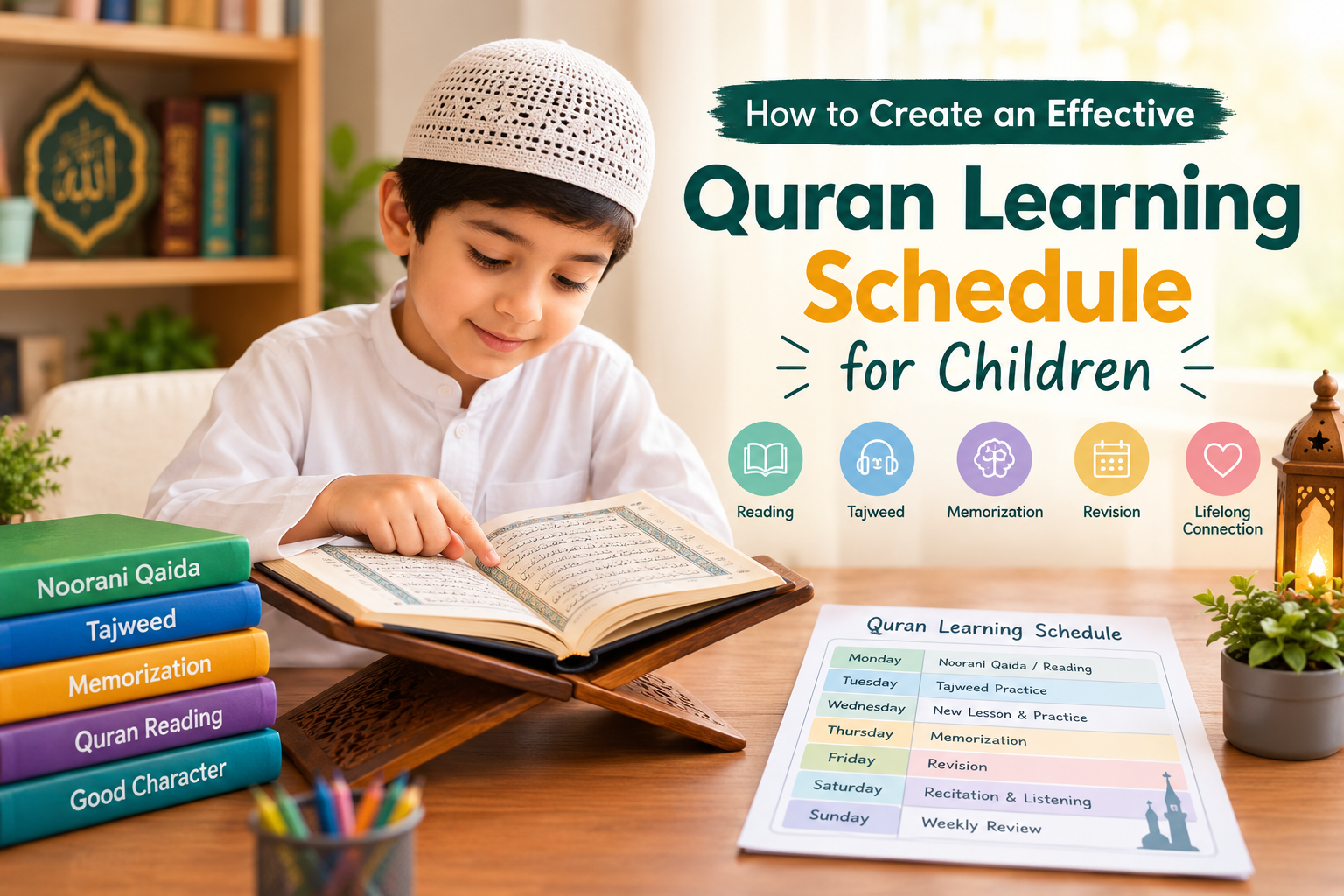
Helping children develop a strong connection with the Holy Quran is one of the most valuable investments parents can make in their upbringing. However, teaching children to read the Quran regularly requires more than simply setting aside a few minutes each day. It involves creating a balanced learning routine that matches their age, attention span, school commitments, and individual learning abilities.
A well-organized Quran learning schedule can help children improve their Arabic reading skills, understand basic Tajweed rules, develop consistency, and gradually build a lifelong relationship with the Quran.
Whether a child is just beginning with Noorani Qaida or has already started reading the Holy Quran, a structured routine can make the learning process more manageable and enjoyable.
In this guide, we will explore practical ways parents can create an effective Quran learning schedule for children while maintaining a healthy balance between religious education, schoolwork, and recreational activities.
Understand Your Child’s Age and Learning Ability
The first step in creating an effective Quran learning routine is understanding your child’s age, concentration level, and current reading ability. Every child learns differently, so a schedule that works for one child may not be suitable for another.
Younger children generally benefit from shorter and more interactive learning sessions, while older children may be able to concentrate for longer periods.
Consider these general recommendations:
- Ages 4–6: Start with 10–15 minutes of basic Arabic letters, recognition activities, and simple Quranic learning exercises.
- Ages 7–9: Introduce 15–25 minutes of structured learning, including Noorani Qaida, pronunciation practice, and short surahs.
- Ages 10–12: Plan approximately 20–30 minutes for Quran reading, basic Tajweed, memorization, and revision.
- Ages 13 and above: Encourage 30–45 minutes of focused learning, depending on the student’s school schedule and individual capacity.
These are flexible suggestions rather than strict requirements. Parents should adjust the duration according to their child’s progress and ability to concentrate.
Choose the Best Time for Quran Learning
Selecting the right time is essential for building a consistent Quran learning habit. Children are more likely to benefit from their lessons when they are relaxed, attentive, and not overwhelmed by other activities.
Some families prefer Quran learning after Fajr because the morning environment is generally quiet and peaceful. Others find that after-school hours or early evenings work better.
When choosing a suitable time, consider the following factors:
- Avoid scheduling lessons when children are extremely tired or hungry.
- Allow enough time between school activities and Quran lessons.
- Select a consistent time that can be maintained throughout the week.
- Consider your child’s sleep schedule and extracurricular activities.
- Avoid placing Quran lessons too close to bedtime if the child becomes tired easily.
Consistency is more important than selecting a particular hour. A realistic schedule followed regularly is more effective than an ambitious routine that becomes difficult to maintain.
Divide Quran Learning into Small, Manageable Sessions
One of the most common mistakes parents make is expecting children to complete long Quran lessons every day. Extended sessions can reduce concentration and make learning feel like a burden.
Instead, divide each lesson into smaller activities.
For example, a 25-minute session could include:
| Learning Activity | Time |
| Revision of the previous lesson | 5 minutes |
| New Arabic letters or Quran reading | 10 minutes |
| Tajweed and pronunciation practice | 5 minutes |
| Memorization or short surah revision | 5 minutes |
This approach gives children opportunities to practice different skills without becoming overwhelmed.
Parents can also introduce short breaks when necessary, particularly for younger learners.
Start with Noorani Qaida Before Quran Reading
For children who are beginners, learning Arabic letters and their correct pronunciation is an important foundation.
Noorani Qaida helps children recognize Arabic letters, understand their different forms, and practice basic pronunciation rules before progressing to Quranic verses.
A suitable learning progression may include:
- Recognizing Arabic letters individually.
- Learning the correct pronunciation of each letter.
- Understanding letter combinations.
- Practicing basic vowel sounds, including Fatha, Kasra, and Damma.
- Learning Sukoon, Tanween, and other basic reading signs.
- Practicing joined letters and simple Arabic words.
- Moving gradually toward Quranic reading.
Children should be allowed to master each stage before moving forward. Rushing through foundational lessons can lead to pronunciation difficulties later.
Include Tajweed Practice in the Daily Routine
Tajweed refers to the rules that guide the correct pronunciation and recitation of the Holy Quran. Teaching basic Tajweed from an appropriate stage helps children develop accurate reading habits.
Rather than introducing too many rules at once, parents and teachers should gradually explain concepts through examples and repeated practice.
Some important Tajweed topics include:
- Makharij al-Huroof (articulation points of Arabic letters).
- Sifaat al-Huroof (characteristics of letters).
- Madd (elongation).
- Noon Sakinah and Tanween rules.
- Meem Sakinah rules.
- Qalqalah.
- Basic stopping and starting rules.
Children should hear correct recitation, repeat the sounds, and receive gentle corrections when necessary.
Listening to qualified Quran teachers and practicing regularly can help children improve their pronunciation and confidence.
Make Quran Memorization Part of the Weekly Schedule
Memorizing short surahs can help children become familiar with Quranic verses and develop confidence in their recitation.
However, memorization should be introduced according to the child’s ability rather than through pressure or unrealistic targets.
Parents can begin with shorter surahs and gradually increase the amount as the child becomes comfortable.
An effective memorization routine includes three important steps:
New memorization: Introduce a small portion of a surah and repeat it several times.
Daily revision: Review previously memorized verses to strengthen retention.
Weekly revision: Set aside one day to revise all the material learned during the week.
Regular revision is particularly important because children can easily forget previously memorized verses when they continuously move on to new material.
Create a Weekly Quran Learning Timetable
A weekly timetable helps parents organize different learning activities and monitor their child’s progress.
Instead of focusing on the same activity every day, families can introduce variety while maintaining a consistent learning routine.
Here is an example of a weekly Quran learning schedule:
| Day | Learning Activities |
| Monday | Noorani Qaida or Quran reading |
| Tuesday | Arabic pronunciation and Tajweed |
| Wednesday | New Quran lesson and reading practice |
| Thursday | Memorization of a short surah |
| Friday | Revision of previous lessons |
| Saturday | Recitation practice and listening |
| Sunday | Weekly revision and family Quran time |
Parents can adjust this timetable according to their child’s age, school hours, and learning progress.
The main objective is to maintain regular Quran learning without making the schedule unnecessarily demanding.
Make Quran Learning Enjoyable and Interactive
Children learn more effectively when educational activities are interesting and appropriate for their developmental stage.
If Quran lessons become repetitive or stressful, children may gradually lose interest.
Parents and teachers can make the learning experience more engaging through simple activities such as:
- Using colorful Arabic alphabet flashcards.
- Listening to short Quranic recitations.
- Practicing Arabic letters through educational games.
- Encouraging children to repeat short surahs.
- Using positive encouragement after completing lessons.
- Discussing simple meanings of Quranic verses.
- Setting small and achievable weekly learning goals.
It is also important to celebrate progress. Completing a Qaida lesson, improving pronunciation, or memorizing a short surah can be meaningful achievements.
Positive reinforcement helps children associate Quran learning with encouragement and personal growth.
Consider Online Quran Classes for Consistent Learning
Many families have busy schedules because of school, work, and other daily responsibilities. Finding a qualified Quran teacher nearby may also be challenging in some locations.
Online Quran learning can provide a flexible alternative by allowing children to attend lessons from home under the guidance of qualified instructors.
Parents exploring this option can learn more about online Quran classes and the different learning opportunities available for children and beginners.
When choosing an online Quran learning program, consider the following factors:
- Teachers with suitable Quran teaching experience.
- Proper attention to Tajweed and pronunciation.
- Lessons appropriate for the child’s age and skill level.
- Flexible class timings.
- Individual feedback and progress monitoring.
- A safe and supportive online learning environment.
Parents should also remain involved in their child’s learning journey by reviewing lessons, communicating with teachers, and encouraging regular practice between classes.
Track Your Child’s Progress Without Creating Pressure
Monitoring progress helps parents understand whether the learning schedule is effective.
However, progress should not be measured only by the number of pages completed or surahs memorized.
Instead, pay attention to improvements in:
- Recognition of Arabic letters.
- Reading fluency.
- Correct pronunciation.
- Understanding of basic Tajweed rules.
- Memorization and retention.
- Confidence during Quran recitation.
- Consistency in attending lessons.
A simple weekly progress chart can help children see their achievements and stay motivated.
If a child struggles with a particular lesson, parents should identify the difficulty and provide additional practice rather than immediately increasing the workload.
Every child develops at a different pace, and patience is an essential part of Quran education.
Avoid Common Mistakes When Planning Quran Lessons
Even a well-designed schedule may become ineffective if children feel pressured or cannot maintain the routine.
Parents should avoid several common mistakes:
Setting unrealistic targets: Expecting beginners to memorize large portions of the Quran within a short period can create unnecessary stress.
Ignoring revision: Introducing new lessons without reviewing previous material may weaken long-term learning.
Comparing children: Every child has different abilities, so comparisons with siblings or classmates can negatively affect confidence.
Being inconsistent: Frequently changing lesson times makes it difficult to establish a regular learning habit.
Ignoring pronunciation: Encouraging children to read quickly without focusing on correct articulation can create poor recitation habits.
Using punishment as motivation: Quran learning should be encouraged through patience, kindness, and positive reinforcement.
A supportive learning environment helps children develop a genuine interest in reading and understanding the Holy Quran.
Conclusion
Creating an effective Quran learning schedule for children requires patience, consistency, and an understanding of their individual needs. A balanced routine should include Quran reading, Noorani Qaida when appropriate, Tajweed practice, memorization, and regular revision.
Parents should focus on building a positive learning environment rather than setting unrealistic daily targets. Short lessons, engaging activities, qualified guidance, and consistent encouragement can make a significant difference in a child’s Quran learning journey.
Most importantly, children should be encouraged to develop a lifelong connection with the Holy Quran. With a practical timetable and continuous support from parents and teachers, Quran learning can become a meaningful and enjoyable part of their everyday lives.
Frequently Asked Questions (FAQs)
1. How much time should a child spend learning the Quran daily?
The ideal duration depends on the child’s age, concentration level, and learning ability. Younger children may benefit from 10–15 minutes, while older children may manage 20–45 minutes of structured learning.
2. What is the best age to start Quran learning?
Children can begin recognizing Arabic letters and learning basic Quranic concepts at an early age. The learning process should be adapted to their developmental stage and readiness.
3. Should children learn Noorani Qaida before reading the Quran?
Yes. Noorani Qaida provides a foundation in Arabic letters, pronunciation, and basic reading rules, helping beginners prepare for Quranic recitation.
4. How can parents motivate children to read the Quran regularly?
Parents can establish a consistent routine, use interactive learning activities, set achievable goals, celebrate small achievements, and provide positive encouragement.
5. Is online Quran learning suitable for children?
Online Quran learning can be suitable when children receive guidance from qualified teachers through age-appropriate lessons in a safe and supportive environment.
6. How can parents balance Quran learning with schoolwork?
Parents should choose a convenient time, keep lessons manageable, and avoid scheduling Quran classes during periods when children need rest or time for homework.
7. Why is revision important in Quran learning?
Regular revision strengthens memory, improves recitation fluency, and helps children retain previously learned verses and Tajweed rules.