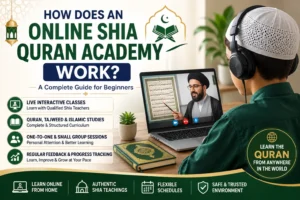
Finding reliable online Quran classes for Shia children can be challenging, especially for families who do not have access to a suitable Shia mosque, madrasa or Quran teacher nearby.
Parents want more than a child who can simply read Arabic words. They want their children to recite the Holy Quran correctly, understand the teachings of Islam and develop a strong connection with Allah, the Holy Prophet Muhammad (PBUH) and the Ahlul Bayt (A.S.).
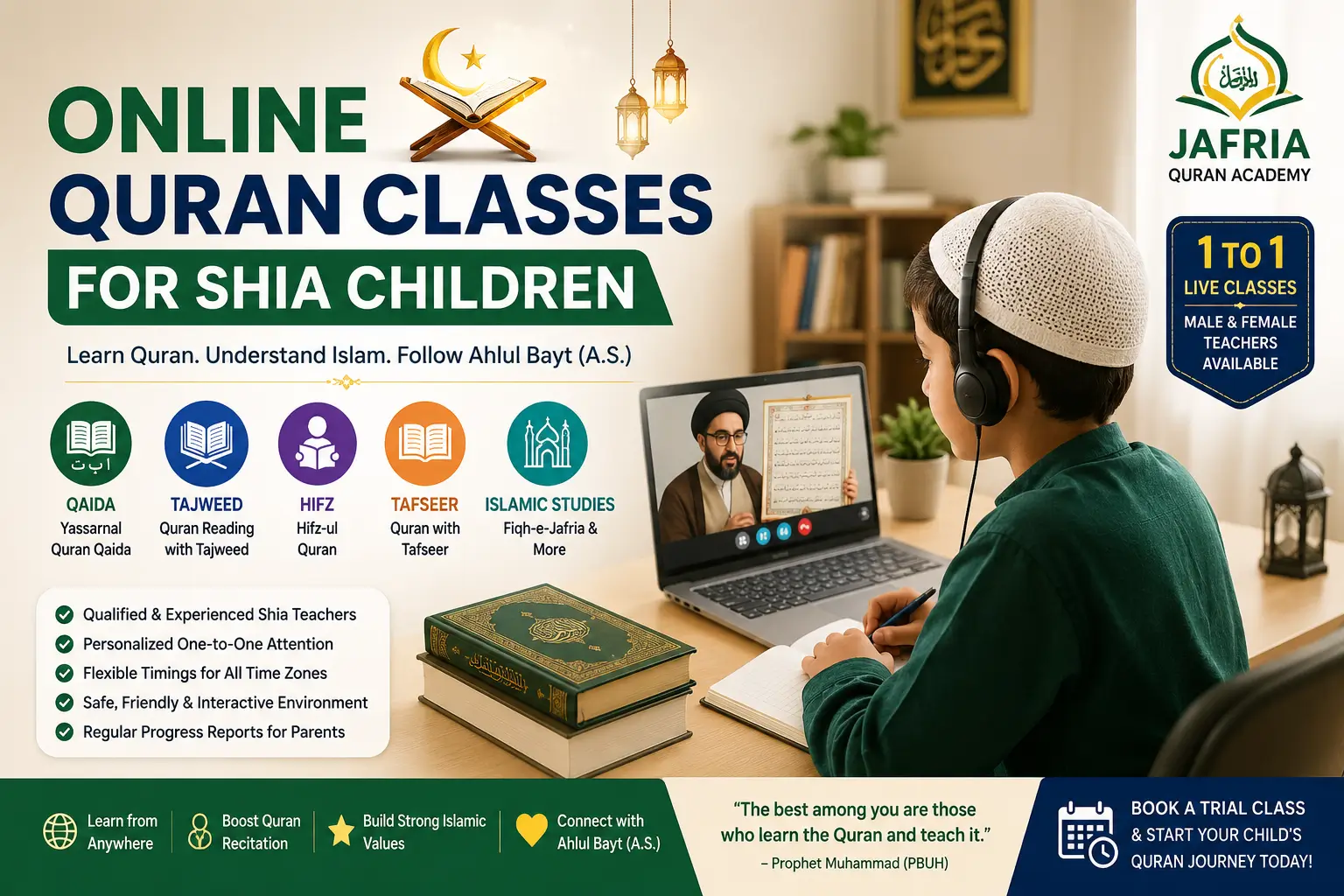
Jafria Quran Academy provides live online Quran and Islamic Studies classes for Shia children through qualified male and female teachers. Lessons are delivered individually, allowing each child to learn according to their age, ability and existing Quran knowledge.
Children can study Yassarnal Quran Qaida, Quran reading with Tajweed, Hifz, Quran translation, Tafseer, Islamic Studies and Fiqh-e-Jafria from the comfort of home.
What Are Online Quran Classes for Shia Children?
Online Quran classes for Shia children are live lessons designed to teach Quran recitation and Islamic knowledge within the beliefs and practices of the Shia Muslim community.
Classes usually take place through platforms such as Zoom, Microsoft Teams or another secure video-learning system. During each session, the teacher listens to the child, corrects mistakes and introduces new material step by step.
Unlike recorded courses, live lessons allow children to ask questions and receive immediate guidance.
Depending on the selected programme, a child may learn:
- Arabic letters and sounds
- Yassarnal Quran Qaida
- Quran reading and recitation
- Makharij and Tajweed rules
- Short-surah memorisation
- Hifz-ul-Quran
- Quran translation
- Basic Tafseer
- Shia Namaz and Wudu
- Usul-e-Deen and Furu-e-Deen
- Duas and Ziyarat
- The lives and teachings of the Ahlul Bayt (A.S.)
- Islamic manners and character
The purpose is to combine Quran-reading skills with meaningful religious education.
Why Shia Families Choose Online Quran Learning
Many Shia families live in places where suitable local tuition is limited. A nearby mosque may not offer children’s classes, while another provider may not teach Islamic Studies according to Fiqh-e-Jafria.
Online learning helps remove that location barrier.
A child in the UK, USA, Canada, Australia, Europe or another region can learn with a Shia Quran teacher without travelling long distances. Parents can also choose class times that fit around school, homework, family commitments and local time zones.
Access to Shia Quran teachers
The strongest reason for choosing a specialist academy is access to teachers who understand Shia beliefs and practices.
This becomes especially important when lessons include:
- Fiqh-e-Jafria
- Shia Namaz
- Wudu and Taharat
- Usul-e-Deen
- Furu-e-Deen
- The Fourteen Masoomeen (A.S.)
- Events from Shia Islamic history
- Nahjul Balagha
- Sahifa Sajjadiya
- Shia duas and Ziyarat
Parents do not need to explain their beliefs to a teacher unfamiliar with their tradition. Instead, Quran recitation and Islamic Studies can be taught within a familiar religious framework.
Convenient learning from home
Online classes remove the need to travel to a madrasa several times each week.
This can help families who:
- Live far from a Shia Islamic centre
- Have several children
- Depend on public transport
- Need evening or weekend lessons
- Have demanding work schedules
- Prefer supervised home learning
- Want access to a male or female teacher
- Move frequently between cities or countries
The child can attend class using a computer, tablet or suitable mobile device with a stable internet connection.
Individual teacher attention
In a large group class, a teacher may have limited time to listen to every child carefully.
One-to-one online lessons create more opportunities for direct correction. The teacher can identify whether the child is struggling with letter recognition, blending, Makharij, fluency, Tajweed or revision.
The pace can then be adjusted accordingly.
A complete beginner may spend more time on Arabic letters, while an experienced reader can focus on advanced recitation or memorisation.
What Children Learn in Our Online Shia Quran Classes
Every child should begin at the correct level rather than being placed into a standard programme based only on age.
A beginner needs a strong reading foundation. By contrast, a child who already reads from the Mushaf may need Tajweed correction, fluency practice or Hifz support.
Yassarnal Quran Qaida for beginners
The Yassarnal Quran Qaida course introduces children to the foundations of Quran reading.
Children gradually learn:
- Arabic letter recognition
- Individual letter sounds
- Different letter forms
- Short vowels or Harakaat
- Sukoon and Shaddah
- Madd and elongation
- Joining Arabic letters
- Reading simple words
- Basic pronunciation rules
- Introductory Makharij
The teacher should not rush a child through the Qaida simply to finish it.
A strong foundation makes future Quran reading easier. Therefore, children should move forward when they can recognise and read the material with reasonable confidence.
Quran reading with Tajweed
After developing basic decoding skills, children can begin reading directly from the Holy Quran.
During live Tajweed lessons, the teacher listens to each passage and corrects pronunciation in real time.
Children may study:
- Correct articulation of Arabic letters
- Heavy and light sounds
- Noon Sakinah and Tanween
- Meem Sakinah
- Qalqalah
- Madd rules
- Ghunnah
- Stopping and starting
- Fluency and rhythm
- Respectful recitation
Tajweed should be introduced gradually. Giving a young learner too many technical rules at once may cause confusion.
Instead, the teacher can demonstrate a rule, practise it in selected words and help the child apply it during recitation.
Hifz and Quran memorisation
Children who are ready for memorisation can study selected surahs, Juz Amma or a wider Hifz programme.
A structured Hifz lesson usually includes:
- Revision of older material
- Correction of weak passages
- Recitation of recently learned verses
- Introduction of new verses
- A clear home-revision target
Revision, also known as muraja’ah, is essential. Learning new verses without reviewing previous portions can lead to weak retention.
For that reason, a suitable Hifz plan should reflect the child’s memory, school timetable and ability to revise consistently.
Quran translation and Tafseer
Reading Arabic is important, but children should also begin understanding the message of the Quran at an age-appropriate level.
Translation and Tafseer lessons can help children explore:
- The basic meaning of selected verses
- Lessons from Quranic stories
- Good character and responsibility
- Worship and obedience to Allah
- Patience, honesty and gratitude
- Respect for parents and family
- Justice and kindness
- Guidance from the Ahlul Bayt (A.S.)
Young children do not need highly technical explanations. Clear stories, examples and practical lessons are usually more effective.
Shia Islamic Studies for children
Islamic Studies helps children connect Quran learning with everyday faith and practice.
A child’s programme may include:
- Tawheed
- Adalah
- Nubuwwah
- Imamah
- Qiyamah
- The Holy Prophet Muhammad (PBUH)
- Sayyida Fatima al-Zahra (S.A.)
- The Twelve Imams (A.S.)
- Wudu
- Namaz
- Fasting
- Khums
- Hajj
- Amr bil Ma’ruf
- Nahi anil Munkar
- Tawalla and Tabarra
- Islamic manners
- Important duas and Ziyarat
Lessons should be adapted to the child’s age. Younger learners may benefit from stories and visual activities, while older children can explore beliefs, history and practical rulings in greater depth.
Online Quran Classes by Age and Learning Stage
Children should not all receive the same lesson length, homework or teaching style.
| Age or stage | Suitable learning focus | Suggested lesson approach |
|---|---|---|
| Ages 3–5 | Listening, Arabic sounds, short surahs and duas | Short, playful lessons |
| Ages 5–7 | Yassarnal Qaida, letter joining and pronunciation | Structured beginner lessons |
| Ages 7–10 | Quran reading, Tajweed and Islamic Studies | Regular guided practice |
| Ages 10–13 | Fluency, Hifz, translation and Fiqh | Goal-based lessons |
| Teenagers | Tajweed correction, Tafseer, Hifz and deeper studies | Personalised programme |
| Late beginners | Qaida, Al-Fatihah and core reading skills | Respectful one-to-one support |
These age ranges are flexible. Readiness and previous experience are more important than a child’s exact birthday.
What Is the Best Age to Start?
Many children can begin structured Quran lessons between the ages of four and seven. However, Quran exposure may begin much earlier through listening, stories, duas and family recitation.
A child may be ready for formal online classes when they can:
- Focus for approximately 10–15 minutes
- Follow simple instructions
- Repeat unfamiliar sounds
- Communicate when they need help
- Respond to gentle correction
- Sit comfortably with an online teacher
- Practise briefly between lessons
Starting later is not a failure. An eight-, ten- or twelve-year-old beginner may progress quickly because they can understand rules and organise their practice more independently.
How Our Online Quran Classes Work
Starting online Quran classes should be simple for both parents and children.
1. Choose a course
Parents first select the programme that best matches the child’s needs.
Available learning paths may include:
- Yassarnal Quran Qaida
- Quran reading with Tajweed
- Hifz-ul-Quran
- Quran translation
- Quran with Tafseer
- Islamic Studies
- Fiqh-e-Jafria
- Nahjul Balagha for suitable older learners
A placement assessment can help when the parent is unsure which level to select.
2. Select a suitable class time
Lessons can be arranged around school, homework, meals and sleep.
Parents should choose a time when the child is alert. A session immediately after a long school day may be less productive than a class after a short break or during a weekend morning.
3. Meet the teacher
A trial lesson gives the parent and child an opportunity to experience the teaching style.
During the trial, observe whether the teacher:
- Speaks clearly
- Corrects mistakes patiently
- Keeps the child engaged
- Understands the child’s starting level
- Uses age-appropriate language
- Gives the child enough time to respond
- Explains what should be practised next
Teacher-child compatibility matters. A knowledgeable tutor may still be unsuitable if the child cannot understand or communicate comfortably with them.
4. Begin live one-to-one lessons
Once the schedule is confirmed, the child attends regular live classes.
The teacher can share the Qaida page, Quran passage, worksheet or Islamic Studies material on screen. Children then read, repeat, answer questions and receive corrections.
5. Review progress regularly
Parents should receive clear information about what the child is learning.
Useful progress measures include:
- Letter recognition
- Reading accuracy
- Quran fluency
- Tajweed application
- Memorisation retention
- Islamic knowledge
- Attendance
- Confidence
- Home-practice consistency
Pages completed should not be the only measure of progress.
Male and Female Shia Quran Teachers
Some families prefer a male teacher for boys or a female teacher for girls. Others choose based on experience, language, availability and the child’s comfort.
Both male and female Shia Quran tutors may teach:
- Qaida
- Tajweed
- Quran recitation
- Hifz
- Translation
- Tafseer
- Islamic Studies
- Fiqh-e-Jafria
Before choosing a tutor, parents should consider:
- Quranic qualifications
- Tajweed and Makharij knowledge
- Experience teaching children
- Understanding of Shia beliefs
- Spoken language
- Patience and communication
- Online teaching skills
- Safeguarding arrangements
A certificate or ijazah may demonstrate subject knowledge. Nevertheless, teaching young children also requires patience, organisation and the ability to explain difficult ideas simply.
Languages Available for Shia Children
Shia families live across many countries and speak different languages at home.
Depending on teacher availability, lessons may be delivered in:
- English
- Urdu
- Arabic
- Persian
- Hindi
- Punjabi
- Other commonly spoken languages
For children living in the UK, USA, Canada or Australia, English-speaking tutors can help connect Quran learning with the language children use at school.
Meanwhile, bilingual teaching may help parents who want their children to maintain Urdu, Arabic or another family language.
Benefits of One-to-One Shia Quran Classes
Personalised learning pace
The teacher can spend more time on difficult sounds or reading patterns without making the child feel left behind.
Immediate correction
Pronunciation errors can be corrected as they happen before becoming established habits.
Flexible curriculum
A child can combine Quran reading with short-surah memorisation, Islamic Studies or Fiqh according to family priorities.
Comfortable home environment
Some children feel more confident learning in familiar surroundings, particularly when beginning for the first time.
Easier parent involvement
Parents can remain nearby, monitor lessons and understand what the child should practise.
Flexible scheduling
Families can select lessons around school hours and time-zone differences.
How Long and How Often Should Children Study?
Short, regular lessons are usually more useful than occasional long sessions.
A practical starting guide is:
| Age | Suggested lesson length | Possible frequency |
|---|---|---|
| Ages 3–5 | 10–15 minutes | 1–2 lessons weekly |
| Ages 5–7 | 15–25 minutes | 2–3 lessons weekly |
| Ages 7–10 | 25–30 minutes | 3–5 lessons weekly |
| Ages 10+ | 30–45 minutes | Based on goals |
| Hifz students | Personalised | Regular revision required |
These timings can be adjusted according to concentration, curriculum and teacher advice.
A longer class may work when it includes several activities, such as Quran reading, a story, Islamic Studies and revision. However, expecting a five-year-old to perform concentrated reading for an uninterrupted hour is rarely productive.
How Parents Can Support Quran Learning at Home
The teacher provides guidance, while the family creates consistency.
Establish a small routine
Set aside five to ten minutes for revision at a predictable time.
For example:
- After Fajr
- Before school
- After an afternoon break
- Following Maghrib
- Before the bedtime routine
The best time is one the family can maintain.
Listen before reading
Children often improve pronunciation by hearing a teacher or skilled reciter before attempting a passage.
Use the same recitation repeatedly rather than changing reciters every day.
Review before learning something new
Older Qaida pages, memorised surahs and Tajweed rules should be revisited regularly.
Praise specific effort
Instead of saying only “well done,” identify the improvement:
- “You pronounced that letter more clearly.”
- “You remembered the whole surah.”
- “You corrected your own mistake.”
- “You concentrated very well today.”
Specific praise helps children recognise their progress.
Avoid comparisons
One sibling may memorise quickly, while another develops stronger reading accuracy.
Both forms of progress are valuable. Comparing children can create anxiety and resistance.
Online Safety and Parental Supervision
Children’s online lessons should take place within clear safety boundaries.
Parents should:
- Use a parent-controlled contact account
- Keep younger children in a shared family space
- Remain nearby during lessons
- Know whether classes are recorded
- Understand how recordings are stored
- Avoid private child-teacher messaging
- Know how to report a concern
- Check who supervises tutors
- Review the provider’s safeguarding procedures
A trustworthy academy should welcome reasonable questions about child protection, communication and privacy.
Physical punishment, humiliation, threatening language or aggressive correction should never be accepted in Quran education.
Quran Classes for Children With Additional Learning Needs
Children with autism, ADHD, dyslexia, anxiety, speech difficulties or other learning needs can study Quran successfully when teaching is adapted appropriately.
Helpful adjustments may include:
- Shorter lessons
- Visual schedules
- Movement breaks
- A consistent teacher
- Larger text
- Fewer items on each page
- Repetition across several sessions
- Reduced background noise
- Clear, literal instructions
- Additional response time
- Parent support during class
Parents should explain the child’s strengths and needs before the trial lesson.
A suitable teacher should discuss what can be changed in the lesson rather than treating a learning difference as poor behaviour.
How to Choose the Best Online Shia Quran Academy
Do not choose a provider only because it appears first in search results or offers the lowest fee.
Compare the following factors.
Authentic Shia curriculum
Ask whether Islamic Studies, Fiqh and religious practices are taught according to Fiqh-e-Jafria and the teachings of the Ahlul Bayt (A.S.).
Qualified teachers
Request information about Quranic training, Tajweed knowledge and experience teaching children.
One-to-one attention
Confirm whether the advertised lesson is genuinely individual or part of a group.
Trial class
A free trial allows parents to assess teaching quality before making a longer commitment.
Teacher consistency
Frequent teacher changes can disrupt progress. Ask whether the child will normally study with the same tutor.
Progress feedback
Parents should know what has been completed, what requires revision and what the next goal will be.
Transparent fees
Check:
- Monthly price
- Number of classes
- Lesson duration
- Registration charges
- Books or learning materials
- Missed-lesson policy
- Cancellation conditions
- Sibling discounts
Safe communication
The academy should communicate through parents and provide a clear route for questions or complaints.
Questions to Ask Before Enrolling
Use this checklist when comparing providers:
- Is the curriculum taught according to Fiqh-e-Jafria?
- Does the teacher have experience with children of this age?
- Are male and female teachers available?
- Will the lessons be one-to-one?
- Which Qaida or reading method is used?
- How is Tajweed introduced?
- Is Islamic Studies included?
- How long is each lesson?
- How many weekly classes are recommended?
- Can parents observe the lesson?
- Will the child keep the same teacher?
- How is progress reported?
- What happens when a lesson is missed?
- Can the teacher support additional learning needs?
- Is a free trial or assessment available?
A provider should answer these questions clearly without pressuring you to enrol immediately.
Common Mistakes to Avoid
Starting with lessons that are too long
Young children need short and varied activities.
Rushing through Qaida
Fast completion does not guarantee accurate reading.
Choosing a teacher only because they are available
Subject knowledge, child-teaching ability and communication all matter.
Focusing only on memorisation
A child also needs revision, reading skills, pronunciation and understanding.
Giving too much homework
Overloading a child can turn Quran practice into a daily conflict.
Ignoring the child’s concerns
Fear, tiredness or repeated reluctance may indicate an unsuitable timetable or teacher.
Measuring progress only by pages
Accuracy, confidence and retention are equally important.
Frequently Asked Questions
Q1: What are online Quran classes for Shia children?
They are live Quran and Islamic Studies lessons taught by teachers familiar with Shia beliefs, Fiqh-e-Jafria and the teachings of the Ahlul Bayt (A.S.). Courses may include Qaida, Tajweed, Hifz, Tafseer and Islamic Studies.
Q2: At what age can a child start?
Many children can begin short structured lessons between ages four and seven. Younger children may start with listening, duas, stories and brief parent-supported activities.
Q3: Are the classes one-to-one?
One-to-one classes allow the teacher to focus on one child’s reading, pronunciation and progress. Parents should confirm the format before enrolling because some providers also offer group programmes.
Q4; Can complete beginners join?
Yes. A beginner can start with Yassarnal Quran Qaida, Arabic letters and basic sounds before progressing to Quran reading.
Q5: Are female Shia Quran teachers available?
Female tutors may be available for girls, young children and families who prefer a female teacher. Availability depends on the selected timetable and course.
Q6: Can children learn Tajweed online?
Yes. During a live lesson, the teacher can listen to the child’s recitation and correct Makharij, elongation, Ghunnah and other Tajweed rules in real time.
Q7: Do children learn Fiqh-e-Jafria?
A specialist Shia Islamic Studies programme may cover beliefs, worship and practical topics according to Fiqh-e-Jafria. Parents should confirm the exact curriculum with the academy.
Q8; Can my child memorise the Quran online?
Yes. Online Hifz classes can include new memorisation, daily revision and teacher correction. Success depends on regular attendance and consistent muraja’ah at home.
Q9: What equipment is required?
Most children need a computer, tablet or suitable mobile device, a stable internet connection, a microphone and the required Qaida or Quran text.
Q10: How do I know whether the teacher is suitable?
Observe a trial class. Look for patience, clear explanations, correct recitation, age-appropriate teaching and a respectful response to mistakes.
Q11; What happens if my child has already started elsewhere?
The new teacher can assess the child’s reading level, Tajweed, memorisation and current book before recommending the next stage.
Q12; How much home practice is needed?
Young beginners may start with five to ten minutes. Older readers and Hifz students may require longer, more frequent revision based on their goals.
Start Online Quran Classes for Your Child
A child’s Quran journey should begin with correct foundations, patient teaching and a positive learning environment.
Through online Quran classes for Shia children, families can access Quran recitation, Tajweed, Hifz and Islamic Studies even when a suitable local teacher is unavailable.
Jafria Quran Academy offers personalised online learning with male and female Shia teachers. Children can begin at foundation level with Yassarnal Quran Qaida or continue with Quran reading, memorisation, translation, Tafseer and Fiqh-e-Jafria.
Book a trial lesson to assess your child’s current level, meet the teacher and choose a suitable learning plan.
Start your child’s Quran journey from home with structured one-to-one guidance.