Introduction: The Importance of Reading Quran Correctly
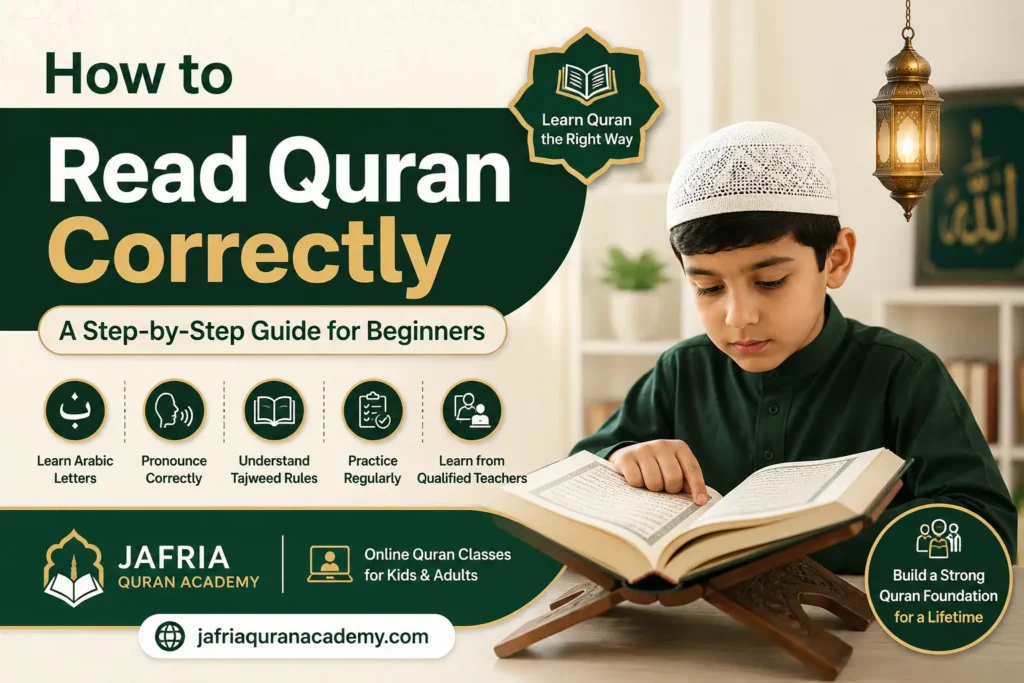
The Holy Quran is the most precious source of guidance for Muslims. Reading the Quran correctly is not only about recognizing Arabic words but also about pronouncing every letter properly, following Tajweed rules, and respecting the words of Allah.
Many beginners start their Quran journey with great enthusiasm, but they may struggle with Arabic pronunciation, letter sounds, and reading flow. Without proper guidance, small mistakes in pronunciation can become difficult habits to correct later.
Learning how to read Quran correctly requires:
- Understanding Arabic letters
- Learning proper pronunciation
- Applying Tajweed rules
- Practicing regularly
- Learning from a qualified Quran teacher
For children especially, building correct Quran reading habits from an early age creates a strong foundation for lifelong Quran recitation.
At Jafria Quran Academy, students learn Quran reading through structured online classes with experienced Shia Quran teachers who focus on correct pronunciation, Tajweed, and personalized guidance.
A proper Quran learning journey helps students:
- Read Quran with confidence
- Avoid pronunciation mistakes
- Improve recitation quality
- Understand basic Quran rules
- Develop a stronger connection with Allah
Why Is It Important to Read Quran Correctly?
The Quran was revealed in Arabic, and every letter has its own pronunciation and characteristics. Reading the Quran correctly helps preserve the original words and meaning of the Holy Quran.
Correct Quran reading is important because:
- Arabic letters have different sounds
- Changing pronunciation can change meanings
- Tajweed protects accurate recitation
- Proper reading improves understanding
Just like learning any language, Quran reading requires learning the basics before becoming fluent.
Start With Learning Arabic Letters
The first step in learning how to read Quran correctly is understanding Arabic letters.
Children and beginners should first learn:
- Names of Arabic letters
- Shapes of letters
- Different forms of letters
- Correct sounds
Arabic has 29 letters, and each letter has a specific pronunciation.
Learn the Correct Sounds of Arabic Letters
Recognizing letters is not enough. Students must learn how each letter sounds.
Some Arabic letters may look similar but have different sounds.
For example:
- س and ص
- ت and ط
- د and ض
- ه and ح
- ك and ق
A beginner Quran student needs proper guidance to understand these differences.
Understanding Makharij: The Foundation of Correct Quran Reading
Makharij refers to the places from where Arabic letters are pronounced.
Every Quranic letter has a specific point of articulation.
The main areas of Makharij include:
- Throat
- Tongue
- Lips
- Nose
- Mouth
Learning Makharij helps students pronounce Quranic letters accurately.
Important Arabic Letters That Require Practice
Some Arabic letters are challenging for beginners because they are not commonly found in other languages.
These include:
ح (Haa)
This letter comes from the middle part of the throat and should not be pronounced like the English “H.”
ع (Ain)
Ain is a special Arabic letter that requires practice from the throat.
ق (Qaaf)
Qaaf comes from the back part of the tongue and should not be confused with ك (Kaaf).
ض (Daad)
Daad is one of the unique Arabic letters and requires correct tongue placement.
A qualified Quran teacher helps students practice these letters correctly.
Learn Noorani Qaida or Yassarnal Quran Before Full Quran Reading
Most beginners do not start directly with the complete Quran. They first learn a beginner Quran book that builds their reading foundation.
Two common methods are:
- Noorani Qaida
- Yassarnal Quran
These books teach:
- Arabic letters
- Joining letters
- Harakat
- Basic Tajweed
- Quran reading preparation
For many Shia families, Yassarnal Quran is commonly used as an initial Quran learning resource because it follows a structured approach used in many Jafari Quran education programs.
Learn Harakat (Arabic Vowel Signs)
Harakat are marks that help students pronounce Arabic words correctly.
The main Harakat include:
Fatha (َ)
Produces an “a” sound.
Example:
بَ
Kasra (ِ)
Produces an “i” sound.
Example:
بِ
Damma (ُ)
Produces an “u” sound.
Example:
بُ
Understanding Harakat allows beginners to read Arabic words correctly.
Practice Joining Arabic Letters
After learning individual letters and vowel sounds, students learn how letters connect to form words.
This step improves reading ability and prepares students for Quranic verses.
Beginners practice:
- Two-letter combinations
- Three-letter words
- Short Arabic words
- Quranic vocabulary
Regular practice builds reading confidence.
How Jafria Quran Academy Helps Students Read Quran Correctly
Learning how to read Quran correctly requires proper guidance, patience, and consistent practice. At Jafria Quran Academy, students receive structured Quran lessons designed to help them build strong reading skills from the beginning.
Our goal is to help children and adults recite the Holy Quran with confidence, correct pronunciation, and proper Tajweed.
Learn Quran With Qualified Shia Quran Teachers
A knowledgeable teacher plays an important role in Quran learning.
At Jafria Quran Academy, students learn from experienced teachers who understand:
- Quran recitation
- Tajweed rules
- Arabic pronunciation
- Makharij
- Jafari Islamic teachings
Teachers provide step-by-step guidance and correct mistakes during every lesson.
One-on-One Quran Classes
Every student learns at a different pace. Some children quickly recognize Arabic letters, while others need more time and practice.
One-on-one classes allow teachers to focus completely on each student’s needs.
During individual lessons, teachers help students improve:
- Letter pronunciation
- Reading fluency
- Tajweed application
- Quran recitation confidence
Personal attention helps students progress more effectively.
Beginner-Friendly Quran Learning Program
Students who have no previous Quran knowledge can start from the basics.
The learning journey usually begins with:
- Arabic alphabet
- Yassarnal Quran
- Harakat
- Word reading
- Basic Tajweed
- Quran recitation
This step-by-step approach prevents confusion and creates a strong foundation.
Flexible Online Quran Classes From Home
Online Quran learning has made it easier for families worldwide to access qualified teachers.
Students can learn Quran from the comfort of their homes without traveling.
Benefits of online Quran classes include:
- Flexible class timings
- Safe learning environment
- Personal teacher attention
- Easy access for international students
- Regular progress updates
This makes Quran education convenient for busy families.
How Parents Can Help Children Read Quran Correctly
Parents play an important role in their child’s Quran learning journey.
Simple support at home can improve learning progress significantly.
Create a Daily Quran Routine
Consistency helps children improve faster.
Parents can encourage:
- Daily Quran practice
- Lesson revision
- Listening to Quran recitation
- Regular homework completion
Even 15–20 minutes of daily practice can create great improvement.
Encourage Without Pressure
Children learn better when they feel supported.
Parents should:
- Appreciate their efforts
- Celebrate progress
- Encourage patience
- Avoid comparing them with others
A positive environment helps children develop love for Quran learning.
Listen to Their Recitation
Parents can improve their child’s confidence by listening to their Quran reading regularly.
This helps children:
- Practice more
- Improve pronunciation
- Feel motivated
- Take Quran learning seriously
Common Questions About Reading Quran Correctly
Q1: How can I learn to read Quran correctly?
You can learn Quran correctly by starting with Arabic letters, learning proper pronunciation, studying Tajweed rules, and practicing regularly with a qualified Quran teacher.
Q2: Can beginners learn Quran reading from zero?
Yes, beginners can start Quran learning from the basics. A structured program begins with Arabic letters, beginner Quran books like Yassarnal Quran or Noorani Qaida, and gradually moves toward Quran recitation.
Q3: How long does it take to learn Quran reading?
The learning time depends on the student’s age, practice routine, class frequency, and dedication. Many beginners develop basic reading skills within a few months with regular lessons.
Q4: Is Tajweed necessary for reading Quran?
Yes, Tajweed is important because it teaches the correct pronunciation and recitation rules of the Quran. It helps students avoid mistakes and read the Quran accurately.
Q5: Can children learn Quran correctly online?
Yes, children can learn Quran online through personalized classes with qualified teachers. Online lessons provide proper guidance, correction, and flexible learning options.
Q6: What should I learn first before reading Quran?
Beginners should first learn:
- Arabic letters
- Letter sounds
- Makharij
- Harakat
- Basic Tajweed rules
These skills create the foundation for correct Quran reading.
Q7: How can I improve my Quran recitation?
You can improve Quran recitation by practicing daily, listening to expert reciters, revising lessons, and learning from a qualified teacher who can correct mistakes.
Final Thoughts
Learning how to read Quran correctly is a beautiful journey that requires patience, dedication, and proper guidance. Correct Quran recitation is not achieved overnight; it develops through continuous learning, practice, and understanding of Tajweed rules.
A strong foundation in Arabic letters, Makharij, and Tajweed helps students avoid mistakes and recite the Holy Quran with confidence and respect.
For children, starting Quran education at an early age creates a lifelong connection with Allah’s words. With the right teacher and consistent practice, every student can improve their Quran reading skills.
Begin Your Quran Learning Journey With Jafria Quran Academy
At Jafria Quran Academy, we provide professional online Quran classes for children and adults who want to learn Quran reading correctly.
Our courses include:
- Yassarnal Quran
- Quran reading for beginners
- Tajweed classes
- Quran memorization
- Islamic education
With experienced Shia Quran teachers, personalized lessons, and flexible schedules, we help students build a strong Quranic foundation from the comfort of their homes.
Start learning Quran correctly today and give yourself or your child the opportunity to develop a lifelong relationship with the Holy Quran.
Related Posts
Best Way to Learn Quran from Home: A Complete Guide for Beginners and Advanced Learners
Best Way to Learn Quran from Home: A Complete Guide…
Best Age to Start Quran Classes for Kids in UK
Many parents ask the same question: what is the best…
What Are Online Shia Quran Classes?
Online Shia Quran classes are live Quran and Islamic education…