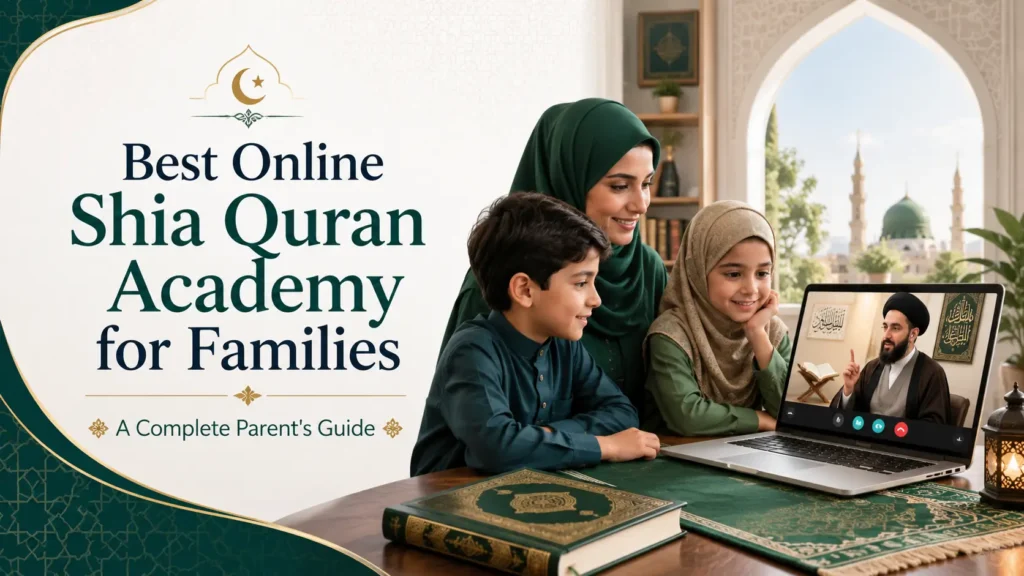
Finding the best online Shia Quran academy for families is about more than choosing someone who can teach your child how to read Arabic. Parents want an Islamic learning environment where children can improve their Quran recitation, understand their faith, learn good Islamic values, and develop a meaningful connection with the teachings of the Ahlul Bayt (A.S.).
This can be especially important for Shia families living in the USA, UK, Canada, Australia, Europe, and other regions where finding an experienced local Shia Quran teacher may not always be easy.
A trusted online Shia Quran academy makes it possible for children, teenagers, adults, and beginners to learn from home with qualified Shia teachers while following a schedule that works around school, work, and family responsibilities.
But how do you know which academy is right for your family?
This guide explains the most important factors parents should consider before enrolling.
What Makes the Best Online Shia Quran Academy for Families?
Every family has different learning needs. One child may be starting with Arabic letters, while another already reads the Quran and needs help with Tajweed. Parents may want Islamic Studies alongside Quran lessons, and adults may need a flexible schedule because of work.
That is why a good family-focused academy should offer more than one standard Quran course.
Parents should look for:
- Qualified Shia Quran teachers
- Education according to Fiqh-e-Jafria
- One-to-one live classes
- Quran courses for kids and adults
- Beginner-level Qaida instruction
- Quran reading with Tajweed
- Hifz and memorization options
- Islamic Studies
- Male and female teachers
- Flexible class timings
- Regular progress monitoring
- Trial classes before enrollment
A strong academy should be able to support students at different ages and learning levels without forcing every family member into the same program.
1. Choose an Academy That Understands Shia Islamic Education
For Shia parents, Quran education is often connected with a much wider understanding of Islam.
Learning how to recite the Holy Quran correctly is essential, but families may also want their children to understand Islamic beliefs, duas, Akhlaq, worship, and the teachings of the Ahlul Bayt (A.S.).
This is why the religious approach of an academy matters.
Shia families should look for Quran classes where teachers understand Fiqh-e-Jafria and can provide Islamic education that is consistent with the beliefs children are learning at home.
This consistency is particularly valuable for younger children. It helps them connect Quran education with their everyday Islamic identity instead of treating Quran class as an isolated academic subject.
At Jafria Quran Academy, Quran and Islamic programs are provided for Shia students through one-to-one online learning according to Fiqh-e-Jafria.
2. Qualified and Patient Shia Quran Teachers Matter
The quality of an online Quran class depends heavily on the teacher.
A good Quran teacher should have strong knowledge, but knowledge alone does not automatically make someone an effective teacher—especially for young children.
A capable online Shia Quran teacher should know how to:
- Correct Quran pronunciation
- Teach Makharij clearly
- Explain basic and advanced Tajweed
- Identify repeated reading mistakes
- Adapt lessons to a student’s ability
- Communicate patiently with children
- Encourage regular revision
- Explain Islamic concepts in simple language
- Keep young students engaged
Children also have different personalities.
Some children are naturally confident and speak freely during lessons. Others are shy and may need several classes before becoming comfortable with their teacher.
The best teachers understand these differences instead of expecting every student to learn in the same way.
Parents can learn more about the academy’s teaching team through the Shia Quran teachers section before selecting a tutor.
3. One-to-One Quran Classes Offer Personal Attention
One-to-one classes can be especially useful for Quran learning because recitation requires individual correction.
Imagine two children of the same age.
One child recognizes Arabic letters easily but has difficulty pronouncing certain sounds correctly. The other pronounces letters well but reads slowly and struggles to join words.
Putting both students through exactly the same lesson at exactly the same pace may not be effective.
With individual lessons, the teacher can identify the student’s actual weaknesses and focus on them.
This can help with:
- Pronunciation
- Makharij
- Fluency
- Tajweed mistakes
- Memorization
- Revision
- Confidence
- Reading speed
One-to-one learning can also allow students to ask questions comfortably without worrying about other students in a group.
For families with several children, each child can follow a learning plan appropriate for his or her current Quran level.
4. Beginners Need a Strong Quran Reading Foundation
Parents sometimes worry that their child does not know enough Arabic to join Quran classes.
A complete beginner should not be expected to start reading directly from the Quran.
A structured foundation course normally begins with Arabic letters, sounds, joining letters, Harakaat, pronunciation, Makharij, and introductory Tajweed.
This creates the foundation needed for independent Quran reading later.
Children and adults who are starting from the beginning can explore the Shia Yassarnal Quran Qaida Course, which is designed to build Quran reading skills step by step.
A good beginner course should prioritize accuracy over speed.
Finishing a Qaida quickly is not necessarily a sign of successful learning. It is better for students to develop correct pronunciation and strong reading habits before moving forward.
Mistakes learned at the beginning can become difficult habits to correct later.
5. Tajweed Should Be an Important Part of Quran Learning
Being able to recognize Quranic words is only one part of recitation.
Students should also learn how Arabic letters are pronounced correctly and gradually understand the rules that govern Quran recitation.
This is the purpose of Tajweed.
Students may learn areas such as:
- Makharij-ul-Huroof
- Noon Sakinah and Tanween
- Ghunnah
- Madd
- Meem Sakinah
- Correct stopping and starting
- Fluency
- Proper pronunciation
Young children do not have to memorize every technical Tajweed term immediately.
A good teacher introduces rules gradually and helps students apply them while reading. As students become more confident, they can develop a deeper understanding of those rules.
Students who already know how to read but want to improve their pronunciation can join structured online Quran classes with Tajweed.
Learning directly with a teacher is particularly useful because pronunciation mistakes can be identified and corrected as they happen.
6. A Family Quran Academy Should Teach More Than Reading
Quran reading is important, but many Shia parents want their children to develop broader Islamic knowledge as well.
A family-focused academy can support this by offering Quranic and Islamic subjects beyond basic recitation.
Depending on a student’s age and level, these may include:
Islamic Studies
Children can learn Islamic manners, beliefs, duas, Shia history, ethics, and teachings related to the Ahlul Bayt (A.S.).
Parents who want to combine Quran lessons with religious education can explore Islamic Studies online for kids.
Quran Translation
Translation helps students begin understanding what the verses they recite mean.
Tafseer
As students grow older, Tafseer can help them explore Quranic messages and meanings in greater depth.
Hifz
Some students may want to memorize selected Surahs, Juz, or larger portions of the Holy Quran.
Nahjul Balagha
Older students and adults may also benefit from studying the wisdom, sermons, and teachings associated with Imam Ali (A.S.).
You can view the available online Shia Quran courses to choose subjects that match each family member’s goals.
7. Male and Female Shia Quran Teachers Give Families More Choice
Teacher preference can be an important consideration when families choose online Islamic education.
Some parents may prefer a female Quran teacher for their daughters or younger children. Women and adult sisters may also feel more comfortable studying with another woman.
Others may prefer male teachers for boys or adult male students.
Providing both options means families can choose a teacher according to their comfort and learning preferences.
Jafria Quran Academy provides access to female Shia Quran teachers online for sisters, girls, and families who specifically prefer female instruction.
This flexibility can be helpful when several members of the same household are learning at once.
A mother, father, son, and daughter can have different tutors while remaining within the same learning system.
8. Flexible Timings Are Essential for Busy Families
Consistency is one of the most important parts of Quran education.
But consistency becomes difficult when Quran lessons constantly conflict with school, work, homework, meals, or other family responsibilities.
One major advantage of online Quran classes is flexibility.
Instead of traveling to a physical madrasa several times a week, students can connect with their teachers from home.
Before enrolling, parents should ask:
- Are classes available around school timings?
- Can students study on weekends?
- Are different time zones supported?
- Can siblings choose different class times?
- Can adults take lessons around work schedules?
- What happens when a student misses a lesson?
The goal should be to find a realistic routine that your family can maintain.
Three consistent lessons each week can be more valuable than an overly demanding schedule that students stop following after a month.
9. Shia Quran Classes for Kids Should Be Encouraging
Children learn best when they feel comfortable making mistakes.
A Quran teacher should correct errors, but correction should not make the child afraid to read.
Patient teachers can help young learners become more confident by breaking difficult lessons into smaller steps, repeating challenging sounds, and recognizing improvement.
Parents should pay attention to how their child responds after the first few lessons.
Ask yourself:
Does my child feel comfortable with the teacher?
Is my child becoming more confident?
Does the teacher explain mistakes patiently?
Can my child tell me what they learned?
Does the child willingly attend the next lesson?
A positive relationship with Quran learning during childhood can be extremely valuable.
The aim is not simply to finish pages. The aim is to help children gradually become confident Quran readers while developing respect and love for the Holy Quran.
10. Parents Should Be Able to Monitor Progress
Although classes happen online, parents should still remain involved in their child’s education.
Progress can be measured in many ways.
For a beginner, improvement might mean correctly recognizing Arabic letters.
For another student, it might mean improving Makharij.
For an advanced learner, progress could mean applying Tajweed more consistently or memorizing new Surahs while retaining previous lessons.
Parents can watch for progress in:
- Arabic letter recognition
- Word formation
- Pronunciation
- Makharij
- Quran reading fluency
- Tajweed
- Memorization
- Revision
- Islamic Studies knowledge
- Confidence
Parents can also support the teacher by encouraging short periods of revision between lessons.
Even a small amount of regular practice can help children retain what they learn.
The academy, teacher, student, and parents should ideally work together.
11. Choose the Right Quran Course for Each Family Member
There is no single course that is right for everyone.
The best starting point depends on the student’s age, current ability, and long-term goal.
For Complete Beginners
A student who cannot recognize Arabic letters can begin with a Shia Quran Qaida course.
For Students Who Already Read Quran
Students who can read but make pronunciation errors may benefit from the Quran with Tajweed course.
For Students Interested in Memorization
Children or adults who want to memorize Quran can explore Hifz Quran online with Shia teachers.
For Children Learning About Islam
Parents who want their children to understand Shia beliefs, Islamic manners, duas, and the teachings of Ahlul Bayt (A.S.) can consider online Islamic Studies for kids.
For Adult Learners
Adults should not feel embarrassed about beginning from the basics.
Some adults learned Quran many years ago but want to correct their pronunciation. Others may be complete beginners.
An experienced teacher should assess the student’s current level and begin from the point that makes sense for them.
Learning the Quran does not have an age limit.
12. Take a Trial Class Before Enrolling Your Family
A website can explain an academy’s courses, teachers, and learning system, but experiencing an actual lesson provides another level of understanding.
That is why a trial class can be extremely useful for parents.
During the trial, observe:
- How the teacher communicates
- How pronunciation mistakes are corrected
- Whether your child feels comfortable
- Whether explanations are easy to understand
- Whether the lesson moves too quickly or slowly
- How well the teacher interacts with young learners
- Whether the schedule works for your family
It is also a good opportunity to discuss your goals.
For example, tell the teacher whether you want your child to begin Quran reading, improve Tajweed, memorize Surahs, or combine Quran education with Islamic Studies.
Families considering enrollment can book a free trial Quran class before beginning regular lessons.
Questions to Ask Before Choosing an Online Shia Quran Academy
Parents should not choose an academy based only on advertising claims.
Ask practical questions first:
- Are your teachers experienced in teaching children?
- Are lessons taught according to Fiqh-e-Jafria?
- Are classes one-to-one or group-based?
- Do you provide male and female teachers?
- Can complete beginners start from Qaida?
- Do you teach Quran with Tajweed?
- Is Hifz available for children and adults?
- Do you offer Islamic Studies?
- Can classes fit around school schedules?
- Are different international time zones supported?
- How can parents monitor progress?
- Is a trial class available before enrollment?
These questions make it easier to compare academies based on actual learning quality rather than simply choosing the first result you find online.
Why Online Quran Learning Works Well for Shia Families
Online learning has made access to Shia Quran teachers much easier.
In the past, families depended largely on teachers or Islamic centers available nearby. That can still work well for many families, but others live too far from a Shia center or cannot find a suitable teacher locally.
Online classes remove that geographic limitation.
A child living in the United States, United Kingdom, Canada, Australia, Europe, or elsewhere can study from home while parents remain nearby.
There is no regular travel, and lessons can often be arranged around existing responsibilities.
Online learning can also work well when different family members are at completely different stages.
For example:
A six-year-old may be learning Arabic letters.
A ten-year-old may be reading Quran with Tajweed.
A teenager may be memorizing Surahs.
A parent may want to improve recitation.
Another adult may want to study Islamic teachings.
Each family member can follow an appropriate learning path without requiring a separate physical institution.
Why Families May Consider Jafria Quran Academy
When comparing options for the best online Shia Quran academy for families, parents should focus on whether the academy’s teaching system matches their needs rather than relying on the word “best” alone.
Jafria Quran Academy offers Quran and Islamic education for children, adults, and beginners through live online learning.
Students can study areas such as:
- Yassarnal Quran Qaida
- Quran reading
- Tajweed
- Hifz
- Quran translation
- Tafseer
- Islamic Studies
- Nahjul Balagha
Families can also choose between male and female tutors depending on their preferences.
The academy follows a one-to-one learning approach, allowing teachers to work directly on each student’s level and learning goals.
Parents who would like to understand the academy, its teaching approach, and its mission can also read more about Jafria Quran Academy.
Final Thoughts: Finding the Best Online Shia Quran Academy for Your Family
The best online Shia Quran academy for families should make authentic Quran education easier to access without compromising teaching quality or Islamic values.
Look for an academy that provides qualified Shia teachers, education according to Fiqh-e-Jafria, one-to-one learning, proper Tajweed instruction, beginner courses, Islamic Studies, male and female tutors, flexible schedules, and opportunities for parents to stay involved.
Most importantly, choose a learning environment where your child feels comfortable, respected, and encouraged to improve.
Quran education is not simply about completing a Qaida, finishing a certain number of pages, or memorizing Surahs as quickly as possible. It is a long-term journey of learning, practice, understanding, and spiritual connection.
With the right teacher and consistent support from parents, online Quran classes can help children and adults improve their recitation, strengthen their Islamic knowledge, and develop a deeper relationship with the Holy Quran and the teachings of the Ahlul Bayt (A.S.).
Ready to see whether online learning is suitable for your family? Start with a free trial class and let the teacher assess the student’s current level before choosing a regular course.
Frequently Asked Questions
Q1: What is the best online Shia Quran academy for families?
The best academy depends on your family’s needs. Look for qualified Shia teachers, Fiqh-e-Jafria education, one-to-one lessons, Tajweed, flexible timings, child-friendly teaching, male and female tutors, and courses for different learning levels.
Q2: Can children learn Quran online with Shia teachers?
Yes. Children can learn Arabic letters, Qaida, Quran reading, Tajweed, memorization, and Islamic Studies through live online classes with experienced Shia teachers.
Q3: At what age can children start online Quran classes?
There is no single age that suits every child. Children can generally begin when they can communicate with a teacher and remain engaged for a short lesson. A patient teacher can adapt lessons to younger learners.
Q4: Are female Shia Quran teachers available online?
Yes. Families who prefer a female tutor can choose female Shia Quran teachers for girls, women, and young learners.
Q5: What should a beginner learn first?
A complete beginner should generally begin with Arabic letters, sounds, joining letters, Harakaat, pronunciation, Makharij, and introductory Tajweed before progressing to independent Quran reading.
Q6: Are one-to-one Quran classes good for children?
One-to-one lessons can be very effective because the teacher can focus directly on the child’s pronunciation, reading mistakes, pace, confidence, and individual learning needs.
Q7: Can adults join online Shia Quran classes?
Yes. Adults can start from basic Quran reading or study Tajweed, Hifz, translation, Tafseer, and other Islamic subjects depending on their current level and goals.
Q8: How can parents help children improve Quran reading?
Parents can establish a regular class schedule, encourage short daily revision, listen to their child’s recitation, stay in communication with the teacher, and recognize steady progress.
Q9: What subjects should a Shia Quran academy offer?
Useful programs may include Qaida, Quran reading, Tajweed, Hifz, Quran translation, Tafseer, Islamic Studies, duas, Fiqh-e-Jafria education, and teachings related to the Ahlul Bayt (A.S.).
Q10: Should families take a trial class before enrolling?
Yes. A trial lesson gives parents an opportunity to observe the teacher’s communication, teaching style, patience, Quran knowledge, lesson structure, and compatibility with the student before beginning regular classes.
Related Posts

Umrah Mubarak Wishes: Heartfelt Messages, Duas, and Congratulations
Umrah Mubarak Wishes: Heartfelt Messages, Duas, and Congratulations Completing Umrah…
Online Quran Classes for Shia Children
Online Quran Classes for Shia Children Finding reliable online Quran…
Fiqh-e-Jafria for Kids: Essential Lessons Every Child Should Learn
Fiqh-e-Jafria for Kids: Essential Lessons Every Child Should Learn A…