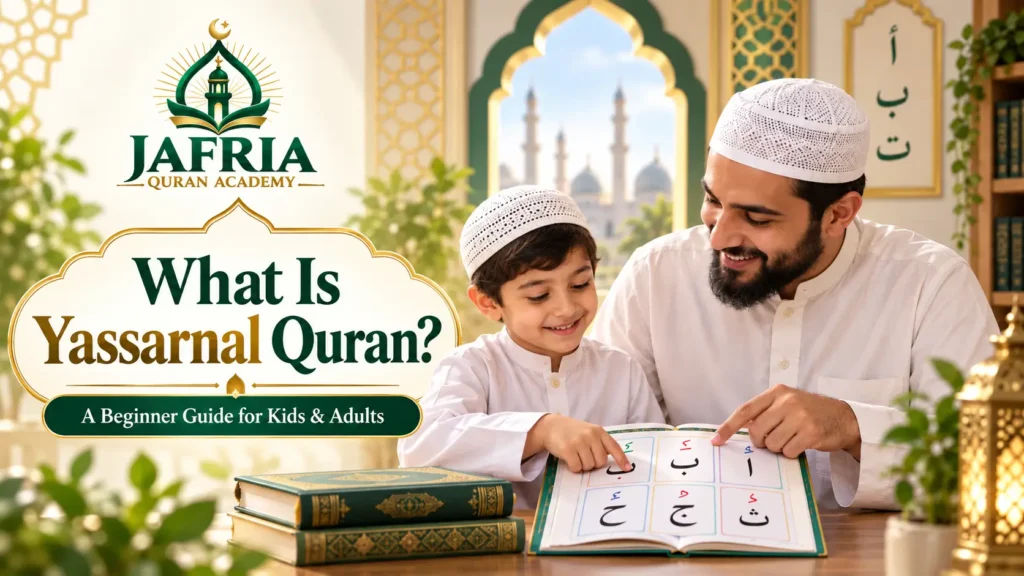
Learning to read the Holy Quran begins with understanding the Arabic letters, their sounds, and the basic reading rules that bring those letters together into words.
For many beginners, especially in Shia Muslim families, Yassarnal Quran is one of the first learning books used to build this foundation.
But what is Yassarnal Quran, how does it work, and what does a student actually learn from it?
Yassarnal Quran is a beginner-level Quran reading primer designed to gradually teach Arabic letter recognition, pronunciation, Harakaat, joined letters, Sukoon, Shaddah, Madd, basic Makharij, and other skills needed before reading complete Quranic verses confidently.
It is suitable for both children and adults who are starting from the beginning or rebuilding weak Quran-reading skills.
The name is connected with the Quranic expression “yassarnā al-Qur’ān”, meaning that Allah has made the Quran easy for remembrance, found in Surah Al-Qamar 54:17.
This guide explains the Yassarnal Quran step by step.
What Is Yassarnal Quran?
Yassarnal Quran, sometimes described as Yassarnal Quran Qaida, is a structured beginner book used to prepare students for Quran reading.
Instead of asking a new learner to begin directly from the Mushaf, the student first develops the skills required to recognize and pronounce Quranic Arabic.
The learning process usually progresses from individual Arabic letters to short vowels, joined letters, word patterns, longer sounds, doubled letters, consonants without vowels, and eventually simple Quranic words and phrases.
The aim is not simply to memorize pages.
The real purpose is to help a beginner understand how Arabic is read.
Once that foundation becomes strong, progressing to direct Quran recitation becomes considerably easier.
It is important to understand that Yassarnal Quran is not a different Quran. It is an educational primer used before or alongside Quran reading.
Why Is It Called Yassarnal Quran?
The term comes from the Arabic expression:
يَسَّرْنَا الْقُرْآنَ
Yassarnā al-Qur’ān
The word Yassarnā carries the meaning of making something easy or facilitating it.
Surah Al-Qamar contains the phrase describing the Quran as having been made easy for remembrance.
The name therefore suits a beginner learning method whose purpose is to make the transition from recognizing Arabic letters to reading Quranic text gradual and manageable.
What Does Yassarnal Quran Teach?
A student normally moves through several connected skills.
The foundation begins with the Arabic alphabet. Students then learn the three short vowel marks—Fatha, Kasra, and Damma—before progressing to joined letters, Tanween, Sukoon, Shaddah, long vowels or Madd, and basic pronunciation from the correct articulation points.
As these concepts become familiar, the student begins combining them rather than reading each rule separately.
For example, a learner eventually needs to recognize immediately that a letter has a Kasra, another has a Shaddah, and a later letter creates a Madd sound.
That ability is what prepares the student for fluent Quran reading.
Yassarnal Quran for Shia Kids
For many Shia families, Yassarnal Quran for kids is used as an early step in Quran education.
Children often benefit from beginning with small, manageable skills instead of being asked to read complete Quranic verses immediately.
A child may first learn to recognize ا، ب، ت، ث and other Arabic letters. The teacher then introduces their sounds, vowel marks, joined forms, and simple combinations.
Repetition is particularly important for young learners.
A child who recognizes ب by itself must eventually learn to recognize the same letter when it appears at the beginning, middle, or end of a joined Arabic word.
An effective teacher therefore does more than ask children to memorize each page. The teacher should listen carefully, correct pronunciation, repeat weak sounds, and make sure the child understands the reading pattern before progressing.
The Arabic alphabet and fundamental reading rules themselves are not different for Shia and Sunni learners. The reason many families specifically search for Shia Yassarnal Quran classes is that they also want their child to learn in an environment consistent with their family’s Shia Islamic education and teachings.
Yassarnal Quran for Adults
Yassarnal Quran is not only for children.
Many adults reach a stage in life when they want to begin Quran reading for the first time or correct reading habits they learned years earlier.
A beginner adult may struggle with Arabic-letter recognition, while another adult may read reasonably well but confuse similar sounds such as:
س and ص
ت and ط
ز and ظ
ح and ه
ق and ك
Starting with a beginner Qaida can help identify these weaknesses without embarrassment.
The benefit of Yassarnal Quran for adults is that the teacher can begin from the learner’s actual level.
Someone who already knows the Arabic alphabet does not necessarily need to spend weeks revising every isolated letter. Instead, the teacher can assess the learner and focus on Harakaat, joining, Makharij, or whichever skills require improvement.
Adults should not feel that beginning with a Qaida is a step backward.
A strong foundation can correct pronunciation habits that may otherwise continue during Quran recitation for years.
Yassarnal Quran Lesson 1
Parents and beginners frequently search for Yassarnal Quran Lesson 1 because they want to understand how the course begins.
The exact arrangement can vary slightly between editions and publishers, so students should follow the edition being used by their teacher.
However, the first stage generally focuses on recognizing individual Arabic letters and producing their basic sounds correctly.
At this stage, the objective is not speed.
A learner should become comfortable identifying letters such as:
ا ب ت ث ج ح خ د ذ ر ز
and continue gradually through the alphabet.
Students should learn to distinguish letters that have similar shapes but different dots.
For example:
ب has one dot below.
ت has two dots above.
ث has three dots above.
Similarly:
ج، ح، خ
share a related basic shape but are distinguished partly by their dot placement.
This visual recognition becomes essential once letters begin joining together.
What Should a Beginner Focus on in Lesson 1?
The most important skills are accurate letter recognition, correct sound production, and avoiding unnecessary additional vowel sounds.
For example, beginners sometimes turn a consonant sound into a complete syllable even when no vowel has been introduced.
A teacher should correct this early.
The goal of Lesson 1 is therefore to create a clean foundation rather than to finish the page as quickly as possible.
Arabic Alphabet in Yassarnal Quran
The Arabic alphabet contains 28 basic letters, and Quran learners need to recognize each one confidently.
However, learning Arabic letters for Quran reading involves more than memorizing their names.
Students also need to understand that the appearance of many letters changes when they join other letters.
Consider the letter ب.
Depending on its position, it may appear in forms resembling:
ب
بـ
ـبـ
ـب
It remains the same letter, but its written shape adapts according to its position.
This is one reason beginners need systematic practice.
Recognizing only isolated letters is not enough to read Quranic words fluently.
Students should gradually be able to identify letters in isolated, initial, medial, and final forms.
Harakaat Explained
After students recognize Arabic letters, one of the most important stages is learning Harakaat.
Harakaat are vowel signs placed above or below Arabic letters to indicate short vowel sounds.
For Quran beginners, the three primary Harakaat are:
Fatha — َ
Kasra — ِ
Damma — ُ
These small signs completely change how a letter is pronounced.
Using the letter ب:
بَ = ba
بِ = bi
بُ = bu
A beginner who understands this pattern can apply the same principle to many other Arabic letters.
This is a major turning point in Yassarnal Quran learning because students move from identifying letters to actually reading sounds.
Fatha, Kasra and Damma
Understanding Fatha, Kasra and Damma is essential before progressing to more complicated Arabic reading patterns.
What Is Fatha?
Fatha (َ) is a small diagonal mark written above a letter.
It normally produces a short “a” sound.
For example:
بَ — ba
تَ — ta
مَ — ma
The sound should remain short unless another rule creates a longer vowel.
What Is Kasra?
Kasra (ِ) appears below the letter.
It normally produces a short “i” sound.
For example:
بِ — bi
تِ — ti
مِ — mi
Students should learn to distinguish this clearly from Fatha.
What Is Damma?
Damma (ُ) appears above the letter and normally creates a short “u” sound.
For example:
بُ — bu
تُ — tu
مُ — mu
A teacher may practice all three together:
بَ بِ بُ
This helps the student understand that the letter remains the same while the vowel changes.
Tanween Explained
After becoming comfortable with basic Harakaat, students are introduced to Tanween.
Tanween occurs when a doubled vowel mark creates an additional “n” sound at the end.
The three common forms are:
ً — Fathatain / Tanween with Fatha
ٍ — Kasratain / Tanween with Kasra
ٌ — Dammatain / Tanween with Damma
For beginner pronunciation purposes, these are often described approximately as:
-an
-in
-un
Tanween becomes especially important later because its pronunciation can change according to Tajweed rules depending on the letter that follows.
At the Yassarnal Quran stage, however, the learner’s first goal is simply to recognize Tanween and produce its basic sound correctly.
Advanced rules can be introduced gradually.
Sukoon Explained
Sukoon (ْ) indicates that a consonant does not carry a short vowel.
For example:
بْ
does not mean ba, bi, or bu.
It represents the consonant sound without an added short vowel.
This concept can initially be difficult for beginners because isolated Arabic-letter practice usually includes a vowel sound.
Students therefore benefit from practicing Sukoon within combinations rather than trying to pronounce every Sakin letter completely independently.
For instance, the first letter may carry a vowel and flow directly into the letter carrying Sukoon.
Learning Sukoon helps students read Arabic syllables and Quranic words much more accurately.
Shaddah Explained
Shaddah (ّ) tells the reader that a consonant is strengthened or effectively doubled.
It is one of the most important signs for Quran reading because ignoring a Shaddah can alter the pronunciation of a word.
Consider:
رَبِّ
The بّ contains a Shaddah.
The reader should not treat it like a single ordinary ب.
A useful beginner explanation is to think of Shaddah as combining two occurrences of the same consonant: the first is Sakin and the second carries the visible vowel.
Students should initially practice Shaddah slowly.
Accuracy should come before speed.
Once the pattern becomes familiar, correct doubled pronunciation begins to occur naturally during recitation.
Madd Letters Explained
Madd refers to lengthening a vowel sound.
Beginners generally first learn the three main Madd-letter patterns:
Fatha + Alif
Kasra + Ya
Damma + Waw
For example:
بَا — bā
بِي — bī
بُو — bū
The important difference is between a short vowel and a lengthened vowel.
Compare:
بَ — ba
with:
بَا — bā
Similarly:
بِ — bi
compared with:
بِي — bī
And:
بُ — bu
compared with:
بُو — bū
Students who fail to distinguish short and long sounds may develop recitation errors, so teachers should correct this from the beginning.
Later Tajweed study introduces different categories and lengths of Madd in greater detail.
At the beginner stage, the priority is understanding the basic long-vowel principle.
How Arabic Letters Join
One of the biggest transitions in Yassarnal Quran occurs when students move from isolated Arabic letters to joined-letter reading.
Arabic is written from right to left, and most letters connect to surrounding letters.
However, not every letter connects in the same way.
Letters such as:
ا د ذ ر ز و
do not connect to the following letter on their left.
Beginners therefore need practice not only identifying letters but also understanding where a connection breaks.
Consider a child who knows every Arabic letter individually but becomes confused when those letters appear inside a word.
This is normal.
Joined-letter reading is a separate skill that requires repeated practice.
A structured progression may begin with two-letter combinations, move to three-letter combinations, then short words, and eventually Quranic vocabulary.
Students should be encouraged to break unfamiliar words into recognizable parts instead of guessing the whole word.
That creates real reading ability rather than memorization.
Makharij for Beginners
Makharij, or Makharij-ul-Huroof, refers to the articulation points from which Arabic letters are pronounced.
Correct Makharij is especially important in Quran recitation because several Arabic sounds may appear similar to learners whose first language is English, Urdu, Hindi, or another non-Arabic language.
For example:
ح should not simply become ه.
ص should not be read exactly like س.
ط differs from ت.
ق differs from ك.
Beginners do not necessarily need to memorize every technical articulation-point category immediately.
Instead, they should first learn to hear and reproduce the correct sound.
A teacher may demonstrate where the tongue, lips, throat, or other speech organs are involved and then ask the student to repeat the sound several times.
Makharij is particularly difficult to learn only from written explanations.
Live correction is valuable because the teacher can hear exactly what the student is producing.
A strong Yassarnal Quran course therefore teaches reading and pronunciation together, rather than waiting until the student has completed the entire Qaida before correcting Makharij.
How the Yassarnal Quran Learning Sequence Works
Although editions and teaching methods may differ, the learning journey generally follows a logical progression.
A student begins by recognizing Arabic letters and their basic sounds. Next come Fatha, Kasra, and Damma, followed by reading simple letter combinations. Joined Arabic letters then teach the learner how familiar characters change shape inside words.
After that, concepts such as Tanween, Sukoon, Shaddah, Madd, and increasingly complex reading patterns are introduced.
Throughout the process, the teacher should continue correcting Makharij.
The final objective is for the student to look at a new Arabic or Quranic word and decode it independently.
That is more valuable than simply memorizing the examples contained in the Qaida.
Is Yassarnal Quran Only for Shia Muslims?
No.
The Arabic alphabet, Harakaat, pronunciation principles, and Quran-reading skills taught through a beginner Qaida are not exclusive to any one Islamic school.
However, Yassarnal Quran is familiar in many Shia educational environments, which is why families frequently search for terms such as Shia Yassarnal Quran, Yassarnal Quran for Shia kids, and online Shia Yassarnal Quran classes.
For Shia parents, the benefit of choosing a Shia learning environment may be that Quran reading is taught alongside religious education consistent with the teachings and practices their family follows.
The reading foundation itself remains focused on learning Quranic Arabic correctly.
Yassarnal Quran vs Direct Quran Reading
Some parents ask whether their child can skip Qaida and start reading the Quran immediately.
For a learner who already understands Arabic letters, vowel signs, joined words, and basic pronunciation, that may sometimes be possible after assessment.
But a complete beginner generally benefits from first learning the reading system.
Starting directly from complex Quranic text can require the student to learn too many skills at once.
A Qaida simplifies the process by isolating one pattern at a time.
First the learner understands the rule.
Then the learner practices it.
Finally, the learner recognizes it naturally inside Quranic words.
This gradual method can create a more stable reading foundation.
How Long Does It Take to Complete Yassarnal Quran?
There is no single correct duration.
Progress depends on the student’s age, starting level, number of classes per week, practice between lessons, concentration, pronunciation ability, and teaching method.
A young child starting from zero may require more repetition than an adult who already recognizes Arabic letters.
Similarly, a student who attends regularly and practices for a few minutes between classes may progress differently from someone who studies only during the lesson.
Parents should therefore be cautious about promises that every student will complete Yassarnal Quran within exactly the same number of weeks.
Correct reading matters more than rushing through pages.
How Parents Can Help Children Learn Yassarnal Quran
Parents do not need to be Quran teachers to support their child’s progress.
A useful routine is to encourage short, consistent revision between classes. Five or ten focused minutes can sometimes be more effective than a long practice session once a week.
Parents can also listen to the child repeat the lesson, make sure classes begin on time, provide a quiet learning environment, and communicate with the teacher if the child is struggling.
Most importantly, children should not feel that mistakes are failures.
Mistakes show the teacher which sound or reading pattern requires more practice.
A patient approach can help children associate Quran learning with confidence rather than anxiety.
Learning Yassarnal Quran Online
Online learning can be particularly useful for families who do not have access to a suitable Quran teacher nearby.
A live online lesson allows the student to see the page, recite directly to the teacher, repeat difficult sounds, and receive immediate correction.
For beginner Qaida students, one-to-one instruction can also allow the teacher to spend additional time on individual weaknesses rather than following the pace of a group.
Jafria Quran Academy currently has a dedicated Yassarnal Quran Qaida pathway for children and adults covering Arabic letters, Harakaat, joined-letter reading, Makharij, basic Tajweed, and preparation for Quran recitation through live learning.
What Comes After Yassarnal Quran?
Completing Yassarnal Quran is not the end of Quran learning.
It is the foundation.
Once a student can recognize Arabic letters, understand their joined forms, apply Harakaat, read Sukoon and Shaddah correctly, distinguish short and long vowels, and pronounce letters reasonably accurately, the learner can begin focusing more directly on Quran recitation.
At that stage, lessons may increasingly cover fluency, advanced Makharij, Tajweed rules, Ghunnah, Madd categories, stopping and starting correctly, and other aspects of recitation.
The transition should depend on readiness rather than simply reaching the final page of the book.
Frequently Asked Questions About Yassarnal Quran
What is Yassarnal Quran?
Yassarnal Quran is a beginner Quran-reading primer that teaches Arabic letters, vowel marks, letter joining, pronunciation, and other foundational skills needed before fluent Quran recitation.
Is Yassarnal Quran suitable for beginners?
Yes. It is designed primarily for students who are learning Quranic Arabic from the beginning or rebuilding weak foundational reading skills.
Can adults study Yassarnal Quran?
Yes. Adults can use Yassarnal Quran to begin from zero or correct weaknesses in Arabic reading and pronunciation.
Is Yassarnal Quran only for children?
No. Although commonly taught to children, the same foundational principles are useful for adult beginners.
What is taught in Yassarnal Quran Lesson 1?
The exact layout depends on the edition, but early lessons generally begin with recognizing individual Arabic letters and learning their correct basic sounds.
Does Yassarnal Quran teach Tajweed?
It provides an introduction to pronunciation and foundational reading concepts that support later Tajweed study. Advanced Tajweed usually continues after the student begins direct Quran recitation.
What are Harakaat?
Harakaat are short vowel signs used in Arabic. Beginners primarily learn Fatha, Kasra, and Damma.
What is the difference between Sukoon and Shaddah?
Sukoon indicates that a consonant has no short vowel, while Shaddah indicates that a consonant is strengthened or doubled.
What are the three basic Madd letters?
The basic long-vowel patterns involve Alif after Fatha, Ya after Kasra, and Waw after Damma.
Why are Makharij important?
Makharij help students pronounce Arabic letters from their correct articulation points, reducing pronunciation errors during Quran recitation.
Final Thoughts
Understanding what Yassarnal Quran is helps parents and adult beginners see why a strong foundation matters before fluent Quran reading.
The course begins with something as simple as recognizing Arabic letters, but each stage adds an important new skill.
Students gradually learn the Arabic alphabet, Fatha, Kasra and Damma, Tanween, Sukoon, Shaddah, Madd letters, joined Arabic writing, and correct Makharij.
When these skills are taught patiently and practiced consistently, beginners become increasingly capable of reading unfamiliar Quranic words rather than merely memorizing lessons.
For Shia children and adults who want to learn in a structured environment, Yassarnal Quran can provide a practical first step toward accurate, confident Quran recitation.
Related Posts
Fiqh-e-Jafria for Kids: Essential Lessons Every Child Should Learn
Fiqh-e-Jafria for Kids: Essential Lessons Every Child Should Learn A…
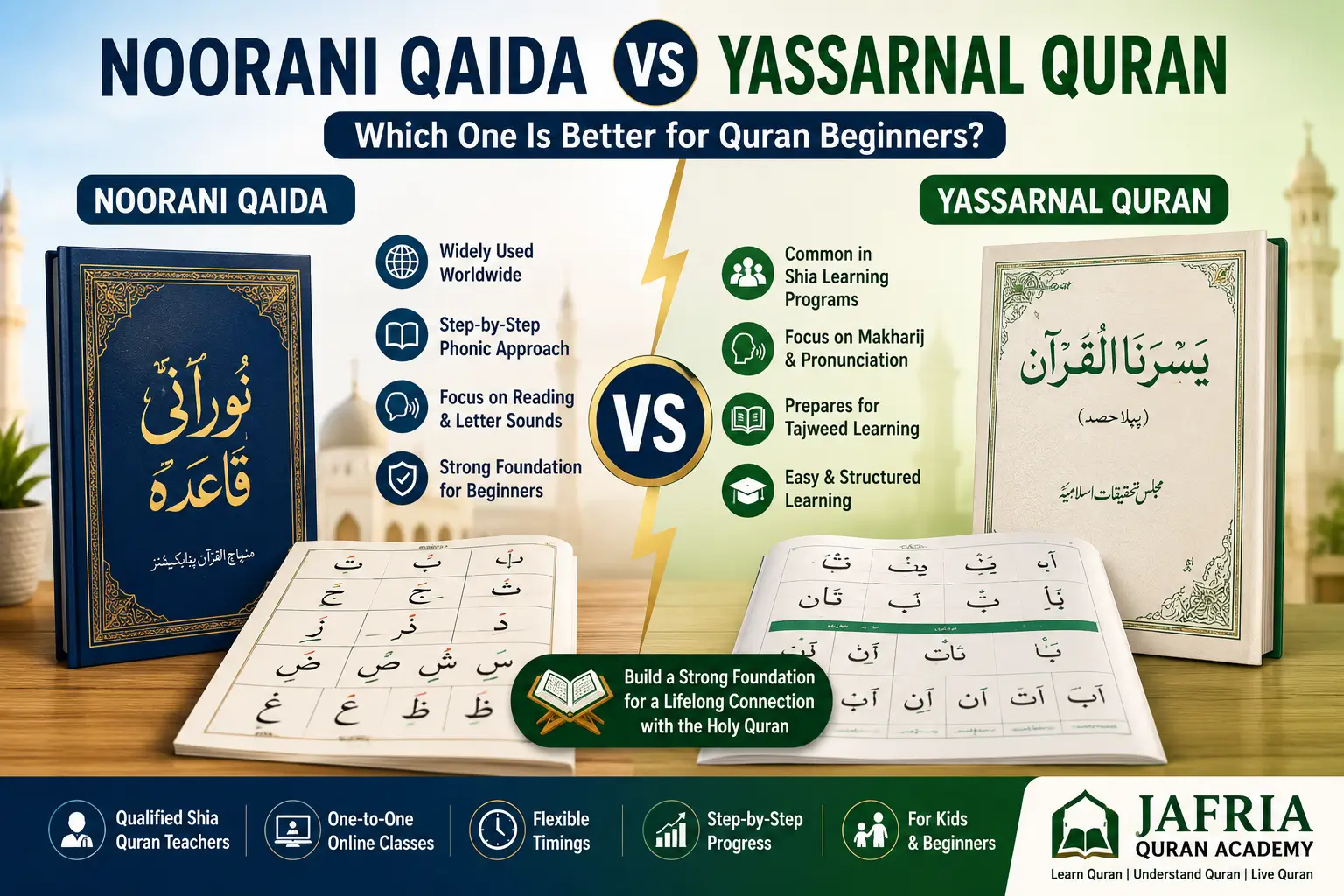
Noorani Qaida vs Yassarnal Quran: Which One Is Better for Quran Beginners?
Introduction: Understanding Beginner Quran Learning Methods Starting Quran learning is…
What Is the Event of Ghadir Khumm? Why Is It So Important?
Event of Ghadir Khumm: What Happened & Why It Matters…