If you’ve spent any time around Shia communities, you’ve probably heard the name Ghadir Khumm mentioned with a kind of reverence usually reserved for Eid itself. In fact, in many households, the 18th of Dhul Hijjah is celebrated as a full holiday — Eid al-Ghadir — complete with recitations, gatherings, and gratitude. But if you’re not familiar with the story, the name alone doesn’t tell you much. Ghadir Khumm is actually the name of a place — a stretch of desert between Mecca and Medina — and what happened there, according to Shia belief, changed the entire course of Islamic history.
Let’s walk through what actually happened, why it matters so deeply, and why it remains one of the most debated events in Islamic memory.
Read this also: How to Read Quran Correctly: A Complete Guide for Beginners
The Setting: The Final Pilgrimage
In the 10th year after Hijrah, the Holy Prophet (peace be upon him and his family) performed what would be his last pilgrimage to Mecca — known as Hajj al-Wida, the Farewell Pilgrimage. Over a hundred thousand Muslims had gathered from across Arabia to perform this journey alongside him. Everyone sensed, in some quiet way, that this pilgrimage carried a different weight than the others.
On the way back to Medina, at a watering place called Ghadir Khumm, where roads split off in different directions toward different tribal homelands, the Prophet suddenly ordered the caravan to stop. This wasn’t a planned rest stop. It was, by nearly every historical account, unexpected and urgent.
The Revelation That Set Everything in Motion
Shortly before this stop, Allah had revealed a verse to the Prophet that carries an almost anxious tone — rare in the Qur’an:
“O Messenger, announce that which has been revealed to you from your Lord, and if you do not, then you have not conveyed His message. And Allah will protect you from the people.” (Surah Al-Ma’idah 5:67)
Notice the phrasing. Allah isn’t simply asking the Prophet to deliver a message — He is telling him that failing to deliver it would mean failing his entire mission, and reassuring him of protection, as if anticipating resistance. Something significant was about to be said.
What Happened at Ghadir
In the intense midday heat, the Prophet had a makeshift pulpit built from camel saddles so the enormous crowd could see him. He then delivered a lengthy sermon, reminding the people of his approaching death, asking them to reflect on his life among them, and reminding them of the Qur’an and his household (the Ahlulbayt) as the two things he was leaving behind for their guidance.
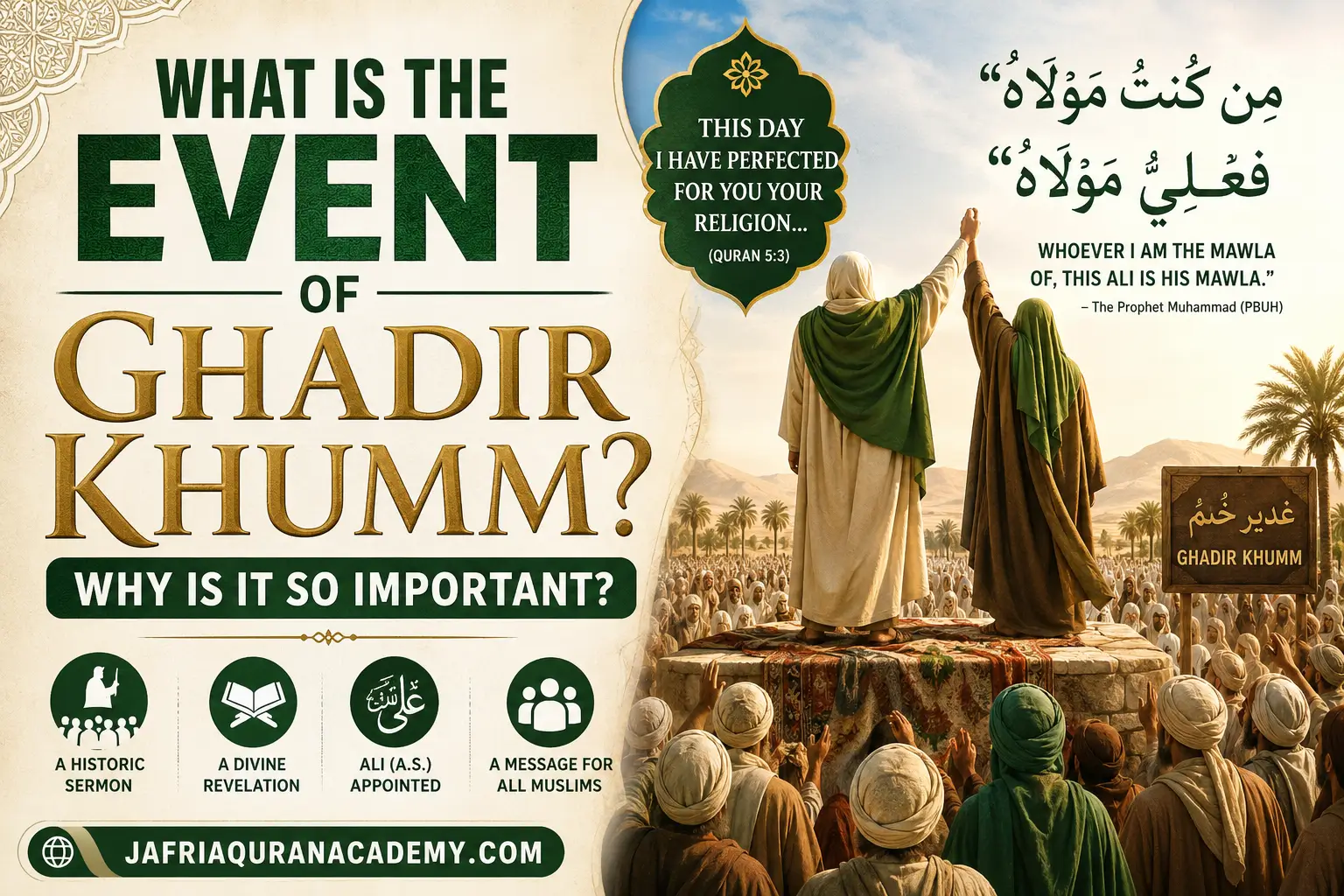
Then came the moment Shia Muslims regard as the turning point of Islamic history. The Prophet took the hand of Imam Ali ibn Abi Talib, raised it so the crowd could see, and declared:
“Man kuntu mawlahu fa hadha Aliyyun mawlahu” “Whoever I am the mawla (master/guardian) of, this Ali is his mawla.”
He then prayed: “O Allah, be a friend to whoever befriends him, and an enemy to whoever opposes him.”
This declaration is not an isolated Shia claim tucked away in obscure books. It’s recorded across major Sunni hadith collections too, including Musnad Ahmad ibn Hanbal, Sunan Ibn Majah, and Sunan al-Tirmidhi (which grades it hasan). Even Sunni scholars who don’t accept the political implications Shia Muslims draw from it acknowledge that the Prophet said these words, in public, in front of an enormous crowd, on his way home from his final Hajj.
Why Shia Muslims See This as a Declaration of Successorship
For Shia Muslims, this wasn’t a vague statement of affection. The word “Mawla” carries real weight — it echoes back to earlier in the same sermon, where the Prophet reportedly asked the crowd, “Am I not more worthy (awla) of you than you are of yourselves?” and the crowd affirmed it. He then followed that acknowledgment immediately with the declaration about Ali, linking the same authority the Prophet held over the believers to Ali.
According to Shia tradition, this event was so significant that Allah revealed a verse shortly afterward:
“This day I have perfected for you your religion and completed My favor upon you and have approved for you Islam as religion.” (Surah Al-Ma’idah 5:3)
Shia scholars — tracing this connection back to narrations from Imam Muhammad al-Baqir — see this as confirmation that the religion was not truly “complete” until the question of leadership after the Prophet was settled through Ali’s appointment. It’s worth noting honestly, though: mainstream Sunni tafsir generally connects this same verse to the completion of the Hajj rites rather than to Ghadir specifically, so this remains a point where Sunni and Shia scholarship genuinely diverge.
Why It Still Matters Today
Ghadir Khumm isn’t just a historical curiosity for Shia Muslims — it’s the foundation of the belief that Imamat, the leadership of the Muslim community after the Prophet, was never meant to be left to human selection or tribal negotiation. It was announced publicly, deliberately, under direct divine command, months before the Prophet’s passing — not decided hastily in a private gathering afterward.
That’s why, every year, Shia communities around the world mark the 18th of Dhul Hijjah with genuine joy. It’s remembered not as a footnote in history, but as the day the Prophet stood before the largest gathering of his followers and made unmistakably clear who he trusted to carry the mantle of guidance forward.
Read this also: Noorani Qaida vs Yassarnal Quran: Which One Is Better for Quran Beginners?
Frequently Asked Questions
1. Where exactly is Ghadir Khumm located? The Ghadir Khumm is a location near a lake/water point in the vicinity of a place known as Juhfah where the roads diverged to different areas of Arabia. It is in this location that the Prophet halted the returning pilgrims and gave his famous sermon.
2. Is this event accepted among Sunni Muslims? Yes, the main event as well as the hadith “man kuntu mawlahu fa Ali mawlahu” has been included in several Sunni hadith literature such as Musnad Ahmad and Sunan al-Tirmidhi. The difference comes in the interpretation of the hadith as Sunni scholars interpret the word “mawla” to mean “friend” while Shias interpret the word as an endorsement of leadership and succession.
3. What is the actual meaning of “mawla”? Mawla is an Arabic word that can refer to master, protector, guardian, ally or friend. Shia scholars have asserted that since the Prophet had told the people moments before that he was more worthy of them than they were of themselves (“awla”), then the word “mawla” must imply that in the case of Ali.
4. Why do Shia Muslims celebrate Eid al-Ghadir? Eid al-Ghadir is celebrated on the 18th of Dhul Hijjah to mark the occasion of this sermon and announcement. For the Shias, it is one of the most important days in the history of Islam since it was on this day that the Messenger made his announcement about the future leader of the Ummah.