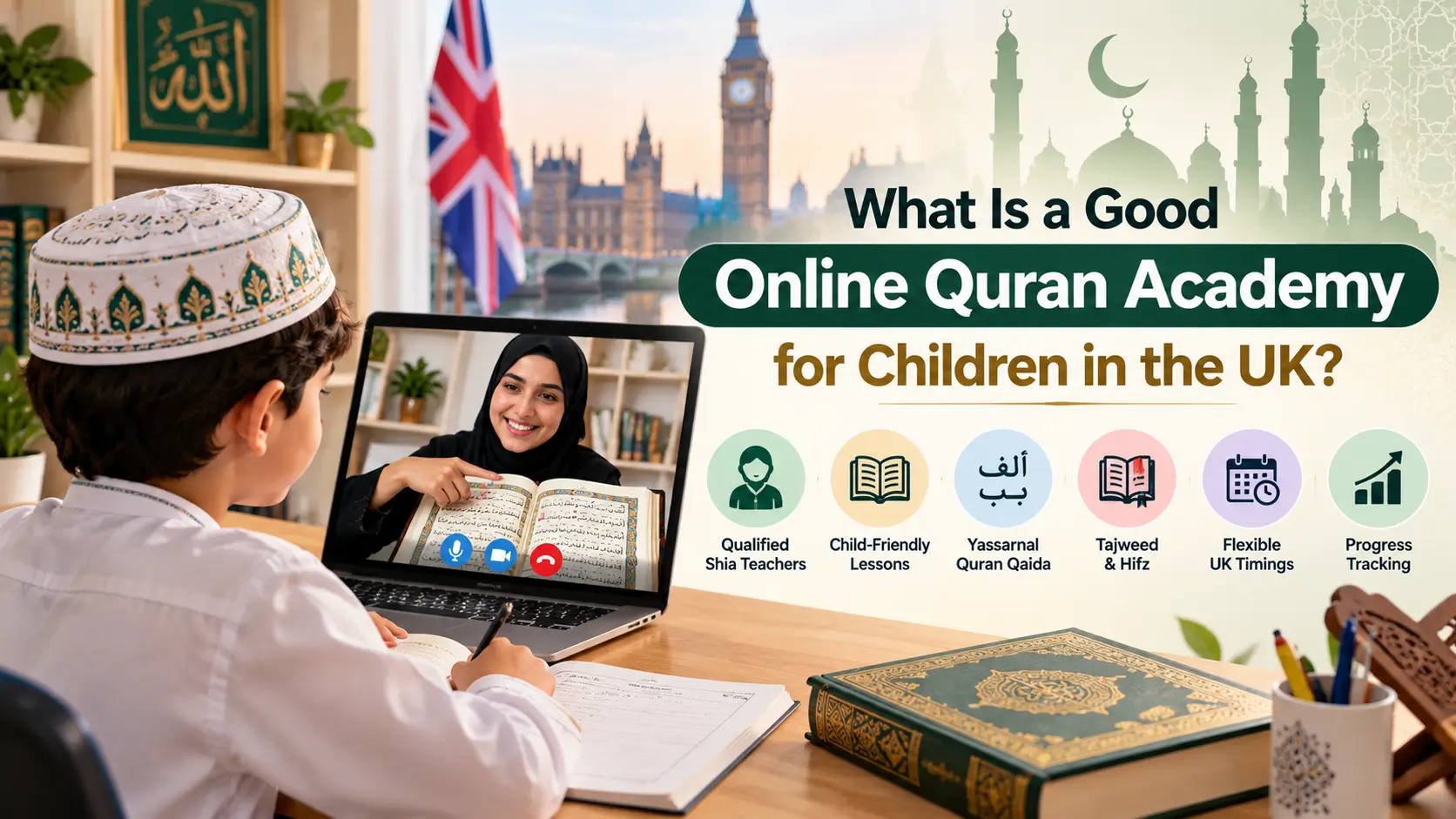
A good online Quran academy for children in the UK should offer more than simply connecting a student with a Quran teacher through a video call. Parents need qualified teachers, child-friendly lessons, correct Quran recitation, structured learning, suitable UK timings and clear communication about their child’s progress.
For Shia families, another important consideration may be whether the academy provides Quran and Islamic education in an environment consistent with Fiqh-e-Jafria and the teachings of Ahlul Bayt (A.S.).
The right academy should help children learn at a comfortable pace while gradually developing correct pronunciation, confidence and a positive relationship with the Holy Quran.
Families looking specifically for faith-aligned learning can explore our online Shia Quran classes in the UK to learn how live one-to-one classes are organised for UK students.
What Makes a Good Online Quran Academy for Children?
Choosing an academy should not be based only on monthly fees or attractive advertisements.
Parents should consider the overall quality of the learning environment.
A good online Quran academy should ideally provide:
- Qualified Quran teachers
- Child-friendly teaching methods
- Correct Tajweed and Makharij
- Live one-to-one lessons
- Structured Quran courses
- Male and female teachers
- Flexible UK timings
- Regular revision
- Progress monitoring
- Parent communication
- Clear attendance and class policies
- A trial before regular enrolment
These features help children receive consistent Quran education rather than disconnected lessons.
1. Qualified Quran Teachers Should Come First
The teacher plays one of the biggest roles in a child’s Quran-learning journey.
Good Quran knowledge is essential, but teaching children also requires patience and communication skills.
A child may need the teacher to repeat a letter several times, explain a rule differently or slow down before moving to the next lesson.
An effective children’s Quran teacher should be able to:
- Demonstrate Arabic sounds correctly
- Recognise pronunciation mistakes
- Explain lessons simply
- Repeat without becoming impatient
- Encourage the child
- Adjust the pace according to ability
- Review previous work regularly
Different children learn at different speeds.
A good academy should therefore avoid treating every student in exactly the same way.
Parents can learn more about the academy’s teaching approach and educational model on the About Jafria Quran Academy page.
2. One-to-One Quran Classes Give Children Individual Attention
Private lessons can work particularly well for young Quran learners.
During a one-to-one class, the teacher can focus completely on one student’s recitation and immediately notice problems such as:
- Confusing Arabic letters
- Weak Makharij
- Incorrect vowel sounds
- Difficulty joining letters
- Repeated Tajweed errors
- Weak revision
- Lack of confidence
This allows lessons to be adjusted according to the child’s actual needs.
One child may require several sessions on Arabic letters, while another might be ready to begin reading directly from the Quran.
Parents can compare the available learning pathways through our online Shia Quran courses.
3. Children Should Be Assessed Before Starting
A good online Quran academy should first understand what the child already knows.
There is little benefit in placing every new student on the same page.
A beginner assessment may consider:
- Arabic-letter recognition
- Previous Qaida study
- Pronunciation
- Harakaat
- Joined-letter reading
- Quran-reading fluency
- Tajweed knowledge
- Memorisation level
This allows the teacher to recommend an appropriate starting point.
The aim is not to give the child an examination.
It is simply to understand what they already know and what they should learn next.
4. Beginners Need a Strong Quran-Reading Foundation
Parents are naturally excited to see their children begin reading the Holy Quran.
However, moving into Quran pages too early can sometimes create reading habits that later require significant correction.
Beginners generally need confidence in areas such as:
- Arabic alphabet recognition
- Correct letter sounds
- Harakaat
- Joining letters
- Sukoon
- Shaddah
- Tanween
- Madd
- Basic Makharij
- Introductory Tajweed
Once these foundations become stronger, Quran reading becomes easier and more accurate.
At Jafria Quran Academy, beginners can start through the online Yassarnal Quran Qaida course, which takes learners step by step from Arabic letters toward Quran reading.
5. Why Yassarnal Quran Can Help Young Beginners
Yassarnal Quran is commonly used as a foundation for learning how to read Quranic Arabic.
Instead of expecting children to understand complete Quranic words immediately, lessons progress gradually.
A learning path may look like:
Arabic letters → correct sounds → Harakaat → joined letters → Quranic words → introductory Tajweed → Quran reading
This structured approach gives children time to understand how Arabic letters look and sound in different positions.
It also allows pronunciation mistakes to be corrected early.
Parents who want to understand the method in greater detail can read our guide on what Yassarnal Quran is and why Shia children learn it.
6. Correct Makharij Should Be Taught From the Beginning
Learning to recognise a word is not enough.
Children should also gradually learn to pronounce Arabic letters from their correct articulation points.
This is particularly important for children growing up in an English-speaking environment because some Arabic sounds do not have direct English equivalents.
Children may initially confuse letters such as:
- س and ص
- ت and ط
- د and ض
- ه and ح
- ك and ق
A live Quran teacher can demonstrate the correct sound, listen to the student and provide immediate correction.
This direct feedback is one of the strongest advantages of live online Quran learning compared with relying only on recorded lessons.
7. Tajweed Should Be Introduced Gradually
Tajweed is important, but young learners should not be overwhelmed by technical terminology.
Beginners can first learn Tajweed practically through listening, repetition and correction.
As their reading improves, they can gradually study concepts such as:
- Makharij-ul-Huroof
- Madd
- Ghunnah
- Qalqalah
- Noon Sakinah and Tanween
- Meem Sakinah
- Waqf
- Correct stopping and starting
The objective is not merely to memorise Tajweed terminology.
Children should learn how to apply the rules during actual Quran recitation.
The online Shia Quran courses page explains how students can progress from beginner Qaida into Quran reading with Tajweed and more advanced learning.
8. UK-Friendly Class Timings Are Essential
A child’s Quran schedule must work alongside everyday life.
Children in the UK often have:
- School
- Homework
- Sports
- Tuition
- Family activities
- Meals
- Rest
An academy serving UK families should therefore understand GMT and BST and offer practical scheduling options.
After-school and evening classes are particularly useful for many families.
The dedicated online Shia Quran classes UK page provides more information about classes arranged around UK family schedules.
Consistency is more important than choosing an unrealistic timetable.
Three classes that a child attends regularly may produce better results than five sessions that are frequently cancelled.
9. How Long Should Children’s Quran Classes Be?
There is no perfect lesson duration for every student.
Younger children generally have shorter attention spans, while older students may be comfortable studying for longer periods.
As a general guide:
| Age | Possible Lesson Length |
|---|---|
| 4–5 years | 10–20 minutes |
| 6–7 years | 20–30 minutes |
| 8–10 years | Around 30 minutes |
| 11+ years | 30–45 minutes |
| Hifz students | According to lesson and revision needs |
These should not be treated as fixed rules.
The child’s concentration, course, previous experience and learning goals should determine the final lesson length.
10. Hifz Needs a Strong Revision System
Quran memorisation involves much more than learning new verses.
A child may memorise quickly but gradually forget previous portions without regular revision.
A structured Hifz programme should therefore include:
- New memorisation
- Recent revision
- Older revision
- Tajweed correction
- Regular listening
- Realistic memorisation targets
Teachers should also consider the child’s school workload and ability.
The objective should be strong and sustainable memorisation rather than simply progressing through pages as quickly as possible.
Families interested in Hifz can review it alongside the other programmes listed on the Quran courses page.
11. Islamic Studies Can Complement Quran Learning
Quran learning is often part of a child’s broader Islamic education.
Depending on their age, children may also study:
- Salah
- Duas
- Islamic manners
- Aqaid
- Fiqh
- Seerat
- Teachings of Ahlul Bayt (A.S.)
- Islamic history
- Ziyarat
- Everyday Islamic values
For Shia families, studying with teachers who understand Fiqh-e-Jafria can help keep Quran learning and religious education consistent with what children learn at home.
Jafria Quran Academy’s complete course selection includes Quran learning alongside Shia Islamic Studies for different age groups and levels.
12. Male and Female Quran Teachers Matter to Many Families
Some parents prefer a male Quran teacher for their son or a female Quran teacher for their daughter.
Other families may have no preference for younger children but want a particular arrangement as the child gets older.
A professional academy should explain what options are available.
Teacher allocation can depend on:
- Student age
- Gender
- Course
- Language
- Preferred class time
- Teacher availability
Parents should mention these preferences before establishing a permanent timetable.
13. Parents Should Know How Their Child Is Progressing
Parents should not have to guess whether lessons are producing results.
Regular communication may cover:
- Current lesson
- Qaida progress
- Reading fluency
- Makharij
- Tajweed
- Memorisation
- Revision
- Attendance
- Home practice
Parents do not necessarily need detailed feedback after every class.
However, they should have a clear idea of what their child is currently learning and which areas require additional practice.
14. Online Safety and Professionalism Matter
Parents should also consider how children’s online lessons are managed.
Useful questions include:
- How are Quran teachers selected?
- Can parents remain nearby during class?
- How is communication with teachers handled?
- Can parents contact academy management?
- What happens if there is a concern?
- Can the teacher be changed?
- How is teaching quality monitored?
Online classes have the advantage of taking place in the home, making it easier for parents to observe their child’s learning.
However, professional communication and clear academy policies remain important.
15. The Teacher Should Correct Without Discouraging the Child
Making mistakes is a normal part of learning Quran.
A good teacher needs to correct those mistakes without making the child afraid to read.
Children generally respond better when correction is calm and specific.
For example, a teacher may ask the student to repeat a particular sound several times before returning to the verse.
Positive teaching does not mean ignoring mistakes.
It means combining accuracy with patience.
Over time, this helps children develop both better recitation and greater confidence.
16. What Is the Best Age to Start Quran Classes?
There is no single age that works for every child.
Some children may be ready for basic Quran learning around four or five, while others may benefit from starting structured Qaida slightly later.
Parents should consider whether their child can:
- Listen for a short period
- Repeat sounds
- Follow simple instructions
- Recognise basic visual patterns
- Accept correction
- Practise briefly outside the lesson
Our detailed guide to the best age to start Quran classes for kids in the UK explains how parents can judge readiness according to age and attention span.
17. How Many Quran Classes Should a Child Take?
The right frequency depends on age, course and family routine.
Two or three lessons each week may work well for younger beginners.
Older students or children working toward Quran fluency, Tajweed or Hifz may benefit from more frequent lessons.
However, consistency matters more than numbers.
A child who attends three lessons every week and revises regularly may make better progress than someone enrolled in five classes but attending irregularly.
18. Online Quran Academy or Local Madrasa?
Neither option is automatically better for every family.
A local madrasa can provide:
- Face-to-face interaction
- Community involvement
- Learning alongside other Muslim children
Online Quran classes offer different benefits:
- No travel
- Flexible scheduling
- One-to-one attention
- Access to teachers outside the local area
- Easier parental observation
- Male and female teacher choices
- Personalised lesson pacing
Some families combine both approaches.
Parents should select whichever arrangement gives their child access to good teaching and a routine they can maintain consistently.
19. Why a Free Trial Class Is Important
Websites can explain courses and teacher qualifications, but they cannot completely show how a particular teacher will interact with your child.
This is why a trial can be useful.
During the trial, parents can observe:
- Teacher punctuality
- Teaching style
- Child-teacher interaction
- Pronunciation correction
- Lesson organisation
- Technology quality
- Whether the child feels comfortable
A trial also helps the teacher understand the child’s current level before recommending a regular learning plan.
Families who want to experience the teaching first can explore the academy’s online Shia Quran classes with a free trial.
Questions to Ask Before Choosing an Online Quran Academy
Before enrolling your child, consider asking:
- Are lessons live or recorded?
- Are classes private or group-based?
- What qualifications do the teachers have?
- Are male and female teachers available?
- Is the Islamic curriculum appropriate for our family?
- How will my child’s Quran level be assessed?
- Which Qaida is used for beginners?
- How is Tajweed taught?
- Are UK-friendly timings available?
- How long does each class last?
- How will progress be monitored?
- What happens if a class is missed?
- Can we change teachers if necessary?
- Is a trial available before regular enrolment?
An academy that answers these questions clearly gives parents more confidence about what to expect.
Why Choose Jafria Quran Academy for Children in the UK?
Jafria Quran Academy provides online Shia Quran education for children, teenagers and adults, including students throughout the United Kingdom.
Students can begin from their current level rather than being placed into a one-size-fits-all programme.
Available learning pathways include:
- Yassarnal Quran Qaida
- Quran reading
- Tajweed
- Hifz-ul-Quran
- Quran Translation
- Tafseer
- Shia Islamic Studies
- Advanced Islamic learning for suitable students
Classes follow a live one-to-one teaching model with male and female Shia teachers and flexible scheduling for different time zones.
Parents can first explore our online Shia Quran classes for UK families or compare the full range of online Shia Quran courses.
Beginners who need to start from Arabic letters can learn more about the Yassarnal Quran Qaida course.
Families can also begin with a free Quran trial before deciding whether regular classes are suitable.
Final Thoughts
So, what is a good online Quran academy for children in the UK?
A good academy combines correct Quran education with qualified teachers, age-appropriate teaching, individual attention, flexible scheduling and professional communication with parents.
For Shia families, it may also be important that the academy provides Islamic education consistent with Fiqh-e-Jafria and the teachings of Ahlul Bayt (A.S.).
Parents should look beyond price and ask:
Who will teach my child?
How will the teacher correct mistakes?
What learning path will my child follow?
How will progress be monitored?
Does the timetable work around UK school hours?
Can we experience a trial before committing?
The objective should not simply be to finish a Qaida or complete a certain number of Quran pages.
A strong Quran education should help children develop accurate recitation, confidence, Islamic understanding and a meaningful relationship with the Holy Quran.
Frequently Asked Questions
What makes a good online Quran academy for children in the UK?
A good online Quran academy should provide qualified teachers, child-friendly teaching, correct Tajweed, structured lessons, flexible UK timings, individual attention and communication with parents.
Can children learn Quran effectively online?
Yes. Live one-to-one lessons allow a teacher to hear the child’s recitation, identify mistakes and provide immediate correction while adapting the lesson to the student’s level.
What should complete beginners learn first?
Beginners normally need to develop Arabic-letter recognition, pronunciation, Harakaat and joined-letter reading before moving toward full Quran recitation.
Children starting from the beginning can explore the Yassarnal Quran Qaida course.
What is Yassarnal Quran?
Yassarnal Quran is a beginner learning resource that helps students develop Arabic-letter recognition, pronunciation, joined-letter reading and foundational Quran-reading skills.
Parents can read our detailed explanation of Yassarnal Quran for Shia children.
Can children learn Tajweed online?
Yes. Live online lessons allow the teacher to demonstrate pronunciation and Tajweed rules, listen to the student and correct mistakes immediately.
Can children memorise the Quran online?
Yes. Online Hifz can work effectively when lessons include new memorisation, regular revision, Tajweed correction and realistic targets.
At what age should children start Quran classes?
There is no universal age. Some children can begin gentle learning around four or five, while structured lessons may work better for others from six onwards.
Read our full guide on the best age to start Quran classes for kids in the UK.
Are male and female Shia Quran teachers available?
Jafria Quran Academy provides male and female Shia teachers for its online learning programmes, subject to class scheduling and teacher availability.
Are classes available according to UK timings?
Yes. Jafria Quran Academy’s UK classes are designed around UK time zones, including schedules suitable for school-age learners.
Can parents try a class before enrolling?
Yes. Parents can use the academy’s free Quran trial classes to experience the learning environment before choosing a regular programme.