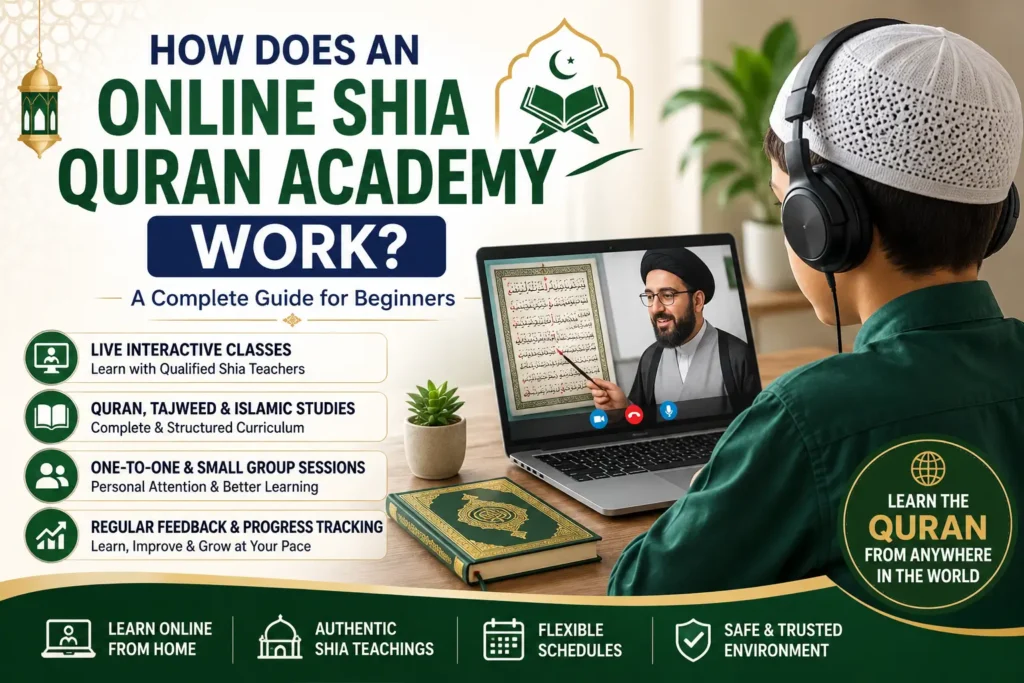
Learning the Holy Quran has become easier than ever before. Today, families no longer need to travel to a mosque or Islamic center to attend regular Quran lessons. With an internet connection and a suitable device, students can learn from experienced Shia Quran teachers right from their homes.
An online Shia Quran academy provides live, interactive classes where students learn Quran recitation, Tajweed, Islamic studies, Fiqh-e-Jafaria, Duas, and other essential subjects under the guidance of qualified teachers. These classes are designed for children, adults, beginners, and advanced learners, making Islamic education accessible to students worldwide.
But many parents and new students still have one important question:
How does an online Shia Quran academy work?
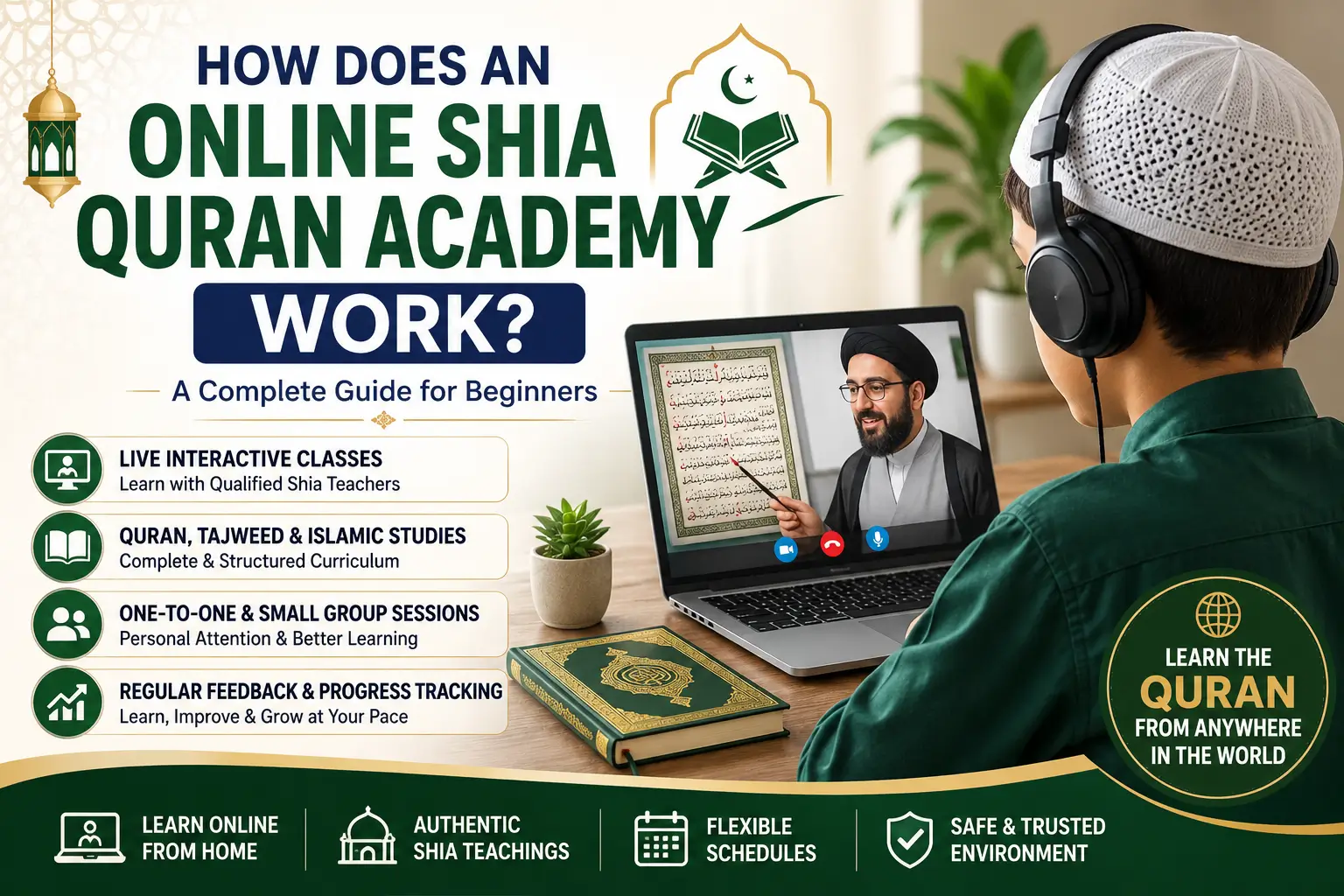
The answer is simple. Students enroll online, choose a suitable class schedule, attend live one-on-one or small group lessons through video conferencing, receive regular feedback from their teachers, and continue learning at their own pace. Modern technology allows teachers to interact with students in real time, correct Quran recitation, answer questions, and monitor progress just like they would in a traditional classroom.
Whether you live in the United States, Canada, the United Kingdom, Australia, Europe, or anywhere else in the world, an online Shia Quran academy makes it possible to receive authentic Islamic education without leaving your home.
At JafriaQuranAcademy.com, for example, students learn through live online sessions with qualified Shia teachers who focus on proper pronunciation, Tajweed, understanding the Quran, and developing a lifelong connection with Islamic teachings. The emphasis is on personalized learning rather than one-size-fits-all lessons.
In this guide, you’ll learn exactly how an online Shia Quran academy works, what happens during a typical class, which courses are available, what technology you need, and how to choose the right academy for yourself or your children.
What Is an Online Shia Quran Academy?
An online Shia Quran academy is a virtual learning platform where students study the Holy Quran and Islamic subjects through live classes conducted over the internet. Instead of attending lessons at a physical institute, students connect with their teachers using video conferencing software such as Zoom, Google Meet, or Skype.
These academies combine qualified Shia instructors, structured lesson plans, and modern technology to create an engaging learning experience for students of all ages. Classes are usually held one-on-one or in small groups, allowing teachers to give personal attention to every student.
The goal is not only to teach Quran reading but also to help students understand Islamic values, improve their recitation, and strengthen their connection with Allah (SWT).
Understanding Online Quran Learning
Online Quran learning follows the same educational principles as traditional classroom teaching. The main difference is that lessons take place through the internet rather than in person.
During each class, the teacher and student communicate through live audio and video. Teachers share digital Quran pages, explain Tajweed rules, listen carefully to each student’s recitation, correct pronunciation mistakes, and answer questions immediately.
Because everything happens in real time, students receive continuous guidance throughout the lesson. Many academies also provide homework, revision plans, and regular assessments to help students improve steadily.
This flexible approach allows families to schedule classes around school, work, and other daily responsibilities.
What Makes a Shia Quran Academy Different?
While every Quran academy teaches the Holy Quran, a Shia Quran academy also includes teachings based on the Ahlul Bayt (AS) and the Ja’fari school of thought.
Depending on the student’s level and chosen course, lessons may include:
- Quran reading with proper Tajweed
- Noorani Qaida for beginners
- Quran memorization (Hifz)
- Quran translation and basic understanding
- Tafsir of selected Surahs
- Fiqh-e-Jafaria
- Daily Duas and supplications
- Islamic manners (Akhlaq)
- Teachings about the lives of the Holy Prophet (PBUH) and the Ahlul Bayt (AS)
Students also have opportunities to ask religious questions in a respectful learning environment where qualified teachers provide guidance according to authentic Shia teachings.
Academies such as JafriaQuranAcademy.com follow structured curricula designed to help students progress step by step, whether they are complete beginners or already have experience reading the Quran.
How Does an Online Shia Quran Academy Work?
An online Shia Quran academy follows a simple and organized learning process. From registration to completing each lesson, every step is designed to make Quran learning easy, interactive, and effective.
Although different academies may have slightly different systems, the overall process is very similar. Students attend live classes with qualified teachers, receive personal guidance, practice regularly, and gradually improve their Quran recitation and Islamic knowledge.
Let’s look at each step in detail.
Step 1: Register for Classes
The first step is completing the online registration process.
Most online academies have a simple registration form where students or parents provide basic information, such as:
- Student’s name
- Age
- Country
- Email address
- Preferred class timings
- Previous Quran learning experience
This information helps the academy understand the student’s needs before assigning a teacher.
For example, at JafriaQuranAcademy.com, the registration process is straightforward, allowing families to submit their details online and begin the enrollment process quickly.
The goal is to make getting started as easy as possible, even for families who have never taken online Quran classes before.
Step 2: Book a Free Trial Lesson
Many reputable online Quran academies offer a free trial class before regular lessons begin.
A trial lesson allows students and parents to:
- Meet the teacher.
- Understand the teaching style.
- Test the online classroom.
- Check internet and audio quality.
- Ask questions about the courses.
- Decide if the academy is the right fit.
The teacher also uses this opportunity to evaluate the student’s current Quran reading ability.
A free trial helps both the student and the academy create a learning plan that matches the student’s level.
Step 3: Teacher Assessment
Before regular classes begin, the teacher performs a short assessment.
This is not an examination. Instead, it helps identify the student’s current skills.
The teacher may check:
- Arabic alphabet recognition
- Noorani Qaida knowledge
- Quran reading fluency
- Tajweed understanding
- Memorization level
- Pronunciation accuracy
- Confidence while reading
For beginners, the assessment is usually very simple. Students who cannot read Arabic often start with Noorani Qaida before moving on to Quran reading.
Advanced students may begin directly with Tajweed, memorization, Tafsir, or Fiqh-e-Jafaria courses.
Step 4: Personalized Learning Plan
Every student learns differently.
Some children need extra time to recognize Arabic letters, while others may already read the Quran but want to improve Tajweed.
After the assessment, the teacher prepares a personalized learning plan based on:
- Student’s age
- Current skill level
- Learning goals
- Available study time
- Preferred schedule
For example:
- A six-year-old beginner may start with Noorani Qaida.
- A teenager may focus on Tajweed and fluent recitation.
- An adult learner may study Quran translation and Tafsir.
- A Hafiz may work on revision and strengthening memorization.
A personalized approach helps students progress at a comfortable pace without feeling overwhelmed.
Step 5: Attend Live One-on-One Classes
Once the schedule is finalized, students begin attending live online classes.
This is one of the biggest advantages of online Quran learning.
Instead of watching pre-recorded videos, students interact directly with their teacher in real time.
During each session, the teacher:
- Greets the student.
- Reviews previous lessons.
- Listens to Quran recitation.
- Corrects pronunciation mistakes.
- Explains Tajweed rules.
- Introduces new lessons.
- Answers questions.
- Assigns homework.
Because the classes are live, students receive immediate feedback, making learning more engaging and effective.
Many academies, including JafriaQuranAcademy.com, offer one-on-one classes so each student receives individual attention and can learn at a pace that suits them.
Step 6: Regular Homework and Practice
Learning the Quran requires consistent practice.
After every class, teachers usually assign homework to reinforce what was learned.
Homework may include:
- Reading selected Quran verses
- Practicing Tajweed rules
- Memorizing short Surahs
- Revising previous lessons
- Learning daily Duas
- Completing simple Islamic studies activities
Even 15 to 20 minutes of daily practice can significantly improve a student’s confidence and recitation over time.
Parents are encouraged to motivate younger children and help them maintain a regular study routine.
Step 7: Progress Reports for Students and Parents
Tracking progress is an important part of online Quran education.
Teachers regularly evaluate students to identify strengths and areas that need more practice.
Progress reports may include:
- Quran reading improvement
- Tajweed accuracy
- Memorization progress
- Class attendance
- Homework completion
- Overall performance
- Teacher recommendations
For children, these reports help parents stay informed about their child’s learning journey.
Teachers may also suggest additional revision or adjusted lesson plans if a student needs more support in a particular area.
This continuous feedback ensures that students remain motivated and continue improving step by step.
A well-organized online Shia Quran academy combines qualified teachers, live interaction, personalized instruction, and regular progress tracking to create a learning experience that is both flexible and effective. Whether the student is a young child taking their first Quran lesson or an adult seeking a deeper understanding of Islamic teachings, this structured approach makes online learning accessible, engaging, and rewarding.
Who Can Join an Online Shia Quran Academy?
One of the biggest advantages of an online Shia Quran academy is that it welcomes students of all ages and learning levels. Whether someone is learning the Quran for the first time or wants to strengthen their existing knowledge, online classes can be tailored to match their needs.
Most academies offer flexible schedules, personalized lesson plans, and experienced teachers who adapt their teaching style according to the student’s age, confidence, and learning pace.
Children
Many parents enroll their children in online Quran classes to build a strong Islamic foundation from an early age.
Children often begin with Noorani Qaida, where they learn:
- The Arabic alphabet
- Correct letter pronunciation
- Basic Tajweed rules
- Short Surahs
- Daily Duas
- Islamic manners (Akhlaq)
Teachers use simple explanations, repetition, and interactive methods to keep young learners engaged. One-on-one classes also help children feel comfortable asking questions and learning at their own pace.
Adults
It is never too late to start learning the Quran.
Many adults join online Shia Quran academies because they were unable to study the Quran during childhood or wish to improve their recitation and understanding later in life.
Adult students may choose courses such as:
- Quran reading with Tajweed
- Quran translation
- Tafsir
- Fiqh-e-Jafaria
- Daily Duas
- Islamic studies
Since adults often have work and family responsibilities, flexible class timings make it easier to fit Quran learning into their daily routine.
Beginners
Beginners are among the most common students in online Quran academies.
Even if someone cannot read a single Arabic letter, qualified teachers guide them step by step. Lessons usually start with Noorani Qaida before moving on to Quran reading.
Teachers focus on:
- Recognizing Arabic letters
- Correct pronunciation (Makharij)
- Basic Tajweed
- Reading simple words
- Building confidence
There is no need to feel embarrassed about starting from the beginning. Every learner progresses at their own pace.
Advanced Students
Students who already know how to read the Quran can enroll in more advanced courses to deepen their knowledge.
These programs may include:
- Advanced Tajweed
- Quran memorization (Hifz)
- Revision of memorized Surahs
- Quran translation
- Tafsir
- Fiqh-e-Jafaria
- Nahjul Balagha
- Islamic history
Teachers identify the student’s current level and recommend the most suitable course to help them continue improving.
Reverts to Islam
Online Shia Quran academies are also a valuable resource for people who have recently embraced Islam.
New Muslims often look for a supportive and comfortable environment where they can learn the basics without feeling overwhelmed.
Many academies provide beginner-friendly lessons covering:
- Arabic alphabet
- Quran reading
- Daily prayers (Salah)
- Wudu
- Basic Islamic beliefs
- Essential Duas
- Introduction to Shia teachings
Teachers understand that every student’s journey is unique and encourage steady progress through patience and consistent guidance.
What Subjects Are Taught in an Online Shia Quran Academy?
An online Shia Quran academy offers much more than Quran reading. Most academies provide a complete Islamic education that helps students strengthen both their recitation and their understanding of Islam.
The available courses usually depend on the student’s age, experience, and learning goals.
Noorani Qaida
Noorani Qaida is the starting point for beginners.
Students learn:
- Arabic letters
- Correct pronunciation
- Joining letters
- Basic reading rules
- Early Tajweed concepts
A strong foundation in Noorani Qaida makes Quran reading much easier.
Quran Reading with Tajweed
After completing Noorani Qaida, students begin reading the Holy Quran with proper Tajweed.
Teachers focus on:
- Correct pronunciation
- Makharij (points of articulation)
- Rules of Tajweed
- Fluency
- Confidence in recitation
Regular correction helps students improve gradually and avoid common mistakes.
Quran Memorization (Hifz)
Students who wish to memorize the Holy Quran can enroll in Hifz programs.
Teachers provide:
- Daily memorization targets
- Revision schedules
- Recitation correction
- Long-term memorization techniques
- Motivation and progress tracking
Consistent revision plays a key role in strengthening memorization.
Quran Translation
Reading the Quran is important, but understanding its message brings even greater benefit.
Translation classes help students:
- Understand Quranic vocabulary
- Learn the meanings of verses
- Connect with Allah’s message
- Reflect on daily life lessons
Teachers explain the meanings in clear and simple language suitable for the student’s level.
Tafsir of the Holy Quran
Tafsir classes go beyond translation by explaining the background, context, and lessons of Quranic verses.
Students learn about:
- Historical context
- Reasons for revelation
- Practical life lessons
- Moral guidance
- Spiritual development
This deeper understanding helps students appreciate the wisdom of the Holy Quran.
Fiqh-e-Jafaria
A distinguishing feature of many online Shia Quran academies is the teaching of Fiqh-e-Jafaria.
Students study topics such as:
- Purification (Taharah)
- Salah
- Fasting
- Zakat and Khums
- Hajj
- Daily religious rulings
- Islamic responsibilities
Lessons are taught according to the Ja’fari school of thought using authentic sources.
Daily Duas
Learning daily supplications helps students remember Allah throughout the day.
Common topics include:
- Morning and evening Duas
- Before eating
- Before sleeping
- Entering and leaving home
- Traveling
- Seeking protection
- Thankfulness
Teachers also explain the meanings and significance of these supplications.
Nahjul Balagha
Many Shia academies introduce students to Nahjul Balagha, a renowned collection of sermons, letters, and sayings of Imam Ali (AS).
Students explore:
- Wisdom and ethics
- Leadership
- Justice
- Patience
- Character building
- Spiritual growth
These lessons encourage students to apply Islamic values in everyday life.
Islamic Studies
Islamic studies provide students with a broader understanding of their faith.
Topics often include:
- The life of Prophet Muhammad (PBUH)
- The lives of the Ahlul Bayt (AS)
- Islamic history
- Pillars of Islam
- Islamic beliefs
- Good character
- Respect for parents and المجتمع (community)
These lessons help students connect religious knowledge with practical daily living.
Akhlaq (Islamic Manners)
Good character is an essential part of Islamic education.
Teachers encourage students to develop qualities such as:
- Honesty
- Kindness
- Patience
- Respect
- Responsibility
- Generosity
- Forgiveness
Learning Akhlaq alongside Quran studies helps students practice Islamic values both at home and in society.
Which Devices Do You Need for Online Quran Classes?
One of the reasons online Quran learning has become so popular is that it doesn’t require expensive equipment. Most families already have the basic devices needed to attend live classes.
As long as the internet connection is stable and the student can communicate clearly with the teacher, learning can take place from almost anywhere.
Laptop or Desktop
A laptop or desktop computer provides the best learning experience for online Quran classes.
The larger screen makes it easier to:
- Read Quran pages clearly
- View lesson materials
- Follow the teacher’s explanations
- Participate comfortably in longer sessions
Many parents also find it easier to monitor younger children when they use a computer instead of a mobile phone.
Tablet
A tablet is another excellent option, especially for children.
Its touchscreen and portable design make it convenient for students to:
- Join live classes
- Read digital Quran pages
- Practice lessons
- Communicate with their teacher
Many families prefer tablets because they are easy to carry and simple for children to use.
Smartphone
If a laptop or tablet is not available, a smartphone can also be used for online Quran classes.
Most video conferencing apps work smoothly on Android and iPhone devices.
Although the smaller screen may not be ideal for longer lessons, it is still suitable for:
- Live recitation sessions
- Homework discussions
- Revision classes
- Short daily lessons
This flexibility allows students to continue learning even while traveling.
Internet Connection
A reliable internet connection is essential for uninterrupted learning.
A stable connection helps ensure:
- Clear audio
- Smooth video
- Better communication
- Fewer interruptions during class
While high-speed internet is beneficial, many online Quran classes can run effectively on a standard home broadband or a stable mobile data connection.
Headphones and Microphone
Good audio quality is especially important during Quran recitation.
Using headphones with a built-in microphone can:
- Reduce background noise
- Improve pronunciation correction
- Make communication clearer
- Help students focus on the lesson
This is particularly useful when several family members are at home during class time.
Which Apps Are Used for Online Quran Classes?
Modern technology has made online Quran learning simple and accessible. Most academies use trusted video conferencing platforms that allow teachers and students to interact in real time.
These applications support live audio, video, screen sharing, and file sharing, creating an experience similar to a physical classroom.
Zoom
Zoom is one of the most widely used platforms for online Quran classes.
It offers features such as:
- Live video calls
- Screen sharing
- Interactive communication
- Easy access from computers and mobile devices
Teachers can display Quran pages, explain Tajweed rules, and listen to students’ recitation without difficulty.
Google Meet
Google Meet is another popular platform because it is simple and secure.
Students can usually join a class by clicking a meeting link, making it convenient for families who are new to online learning.
Its features include:
- High-quality video
- Clear audio
- Screen sharing
- Easy access through a web browser
Skype
Skype has been used for online education for many years and remains a reliable choice for Quran classes.
It allows teachers and students to:
- Make video calls
- Share learning materials
- Communicate clearly during lessons
Some academies continue to use Skype because many families are already familiar with it.
Microsoft Teams
Microsoft Teams is commonly used for educational programs and provides several useful learning tools.
It supports:
- Live classes
- File sharing
- Group discussions
- Secure communication
Some online Quran academies choose Teams for its organized classroom features, especially when teaching groups of students.
How Long Is Each Online Quran Class?
The length of an online Quran class depends on the student’s age, learning goals, and chosen course. Most academies offer flexible schedules so families can select class durations that fit comfortably into their daily routines.
Class Duration
A typical online Quran lesson lasts between 30 and 60 minutes.
For example:
- Young children often attend 30-minute classes to maintain focus.
- Teenagers and adults may benefit from 45- or 60-minute sessions, especially when studying Tajweed, Tafsir, or Hifz.
The ideal duration depends on the student’s ability to stay engaged and absorb new material.
Weekly Schedule
Most academies offer multiple scheduling options.
Students may choose to attend classes:
- Three days a week
- Four days a week
- Five days a week
- Six days a week
- Daily, depending on their learning goals
A consistent schedule helps students develop a regular Quran learning habit while balancing school, work, and family commitments.
Flexible Timings
One of the greatest advantages of online learning is flexibility.
Students living in different countries often need classes that fit their local time zones.
Many academies, including JafriaQuranAcademy.com, offer flexible scheduling so students from the USA, Canada, the UK, Australia, Europe, and other regions can choose convenient class times without disrupting their daily routines.
Whether someone prefers early morning, afternoon, or evening lessons, flexible timing makes regular Quran study easier to maintain.
What Happens During an Online Quran Class?
Every online Quran class follows a structured lesson plan that keeps students engaged and supports steady progress.
Although the exact format may vary depending on the course and the student’s level, most lessons include the following activities.
Recitation Practice
Each class usually begins with Quran recitation.
The student reads previously assigned verses while the teacher listens carefully.
This allows the teacher to evaluate pronunciation, fluency, and confidence before introducing new material.
Teacher Correction
As the student recites, the teacher provides immediate corrections.
The teacher may help improve:
- Letter pronunciation (Makharij)
- Tajweed application
- Fluency
- Reading rhythm
- Common mistakes
Receiving instant feedback helps students develop correct recitation habits from the beginning.
Revision
Revision is an essential part of Quran learning.
Teachers regularly review previous lessons to ensure students remember what they have learned before moving on to new topics.
This continuous practice strengthens both reading skills and memorization.
Homework
Before the class ends, the teacher assigns homework based on the student’s level.
Homework may include:
- Reading specific Quran verses
- Memorizing short Surahs
- Practicing Tajweed rules
- Revising previous lessons
- Learning a new Dua
Daily practice between classes helps students make steady and lasting progress.
Question and Answer Session
Most classes conclude with a short discussion where students can ask questions.
This gives learners the opportunity to:
- Clarify difficult concepts
- Understand Tajweed rules
- Learn the meanings of Quranic verses
- Discuss Islamic topics related to the lesson
Encouraging questions creates a supportive learning environment and helps students build confidence in their understanding of Islam.
A well-structured online Quran class combines live interaction, personalized guidance, consistent practice, and meaningful feedback. This approach enables students to improve not only their Quran recitation but also their understanding of Islamic teachings, making each lesson both educational and spiritually enriching.
Frequently Asked Questions (FAQs)
How does an online Shia Quran academy work?
An online Shia Quran academy provides live Quran classes over the internet. Students attend scheduled lessons through video conferencing platforms like Zoom or Google Meet, where qualified teachers teach Quran reading, Tajweed, Islamic studies, and other subjects in real time. Lessons are interactive, allowing students to ask questions, receive immediate feedback, and learn from the comfort of home.
Can children learn the Quran online safely?
Yes. Online Quran classes are a safe and convenient option for children when they are conducted by a trusted academy. Reputable academies use secure meeting platforms, qualified teachers, and structured lesson plans. Parents can also monitor classes and stay informed through regular progress updates.
Do I need any special software to attend online Quran classes?
No special software is required. Most academies use widely available applications such as Zoom, Google Meet, Skype, or Microsoft Teams. A computer, tablet, or smartphone with a stable internet connection is usually enough to join live classes.
How many online Quran classes should I take each week?
The ideal number of classes depends on your goals and availability. Many students attend three to five lessons per week, while those following Hifz or intensive programs may choose daily classes. A consistent schedule helps students make steady progress.
Are online Quran classes live or recorded?
Most online Shia Quran academies provide live classes. Live sessions allow teachers to listen to recitation, correct pronunciation, answer questions, and give personalized guidance. Some academies may also provide recorded materials for additional revision, but live teaching remains the primary learning method.
Can adults join an online Shia Quran academy?
Absolutely. Online Quran academies welcome learners of all ages. Whether you are a beginner, want to improve your Tajweed, study Quran translation, or learn Fiqh-e-Jafaria, there are courses designed specifically for adult students.
What subjects are taught in an online Shia Quran academy?
Most academies offer a variety of courses, including:
- Noorani Qaida
- Quran Reading with Tajweed
- Quran Memorization (Hifz)
- Quran Translation
- Tafsir
- Fiqh-e-Jafaria
- Daily Duas
- Nahjul Balagha
- Islamic Studies
- Akhlaq (Islamic Manners)
The available courses may vary depending on the academy and the student’s learning level.
How much do online Shia Quran classes cost?
The cost of online Quran classes varies from one academy to another. Factors such as class frequency, lesson duration, and whether the classes are one-on-one or in groups can affect the fee. Many academies also offer free trial lessons, allowing students and parents to experience the teaching style before enrolling.
Conclusion
An online Shia Quran academy makes it possible for students around the world to learn the Holy Quran and Islamic teachings without leaving their homes. Through live one-on-one or small group classes, qualified teachers guide students in Quran recitation, Tajweed, memorization, Fiqh-e-Jafaria, Tafsir, and other essential subjects in a flexible and supportive learning environment.
Whether you are enrolling a young child, beginning your own Quran learning journey as an adult, or looking to deepen your understanding of Islam, online education offers convenience, personalized instruction, and consistent progress. With the right teacher and a structured curriculum, students can build strong Quranic knowledge while balancing school, work, and family commitments.
If you’re looking for a trusted platform to begin your journey, JafriaQuranAcademy.com provides live online Shia Quran classes for children and adults with experienced teachers, flexible schedules, and personalized learning plans. Choosing a reputable academy is the first step toward developing a lifelong connection with the Holy Quran and the teachings of the Ahlul Bayt (AS).