
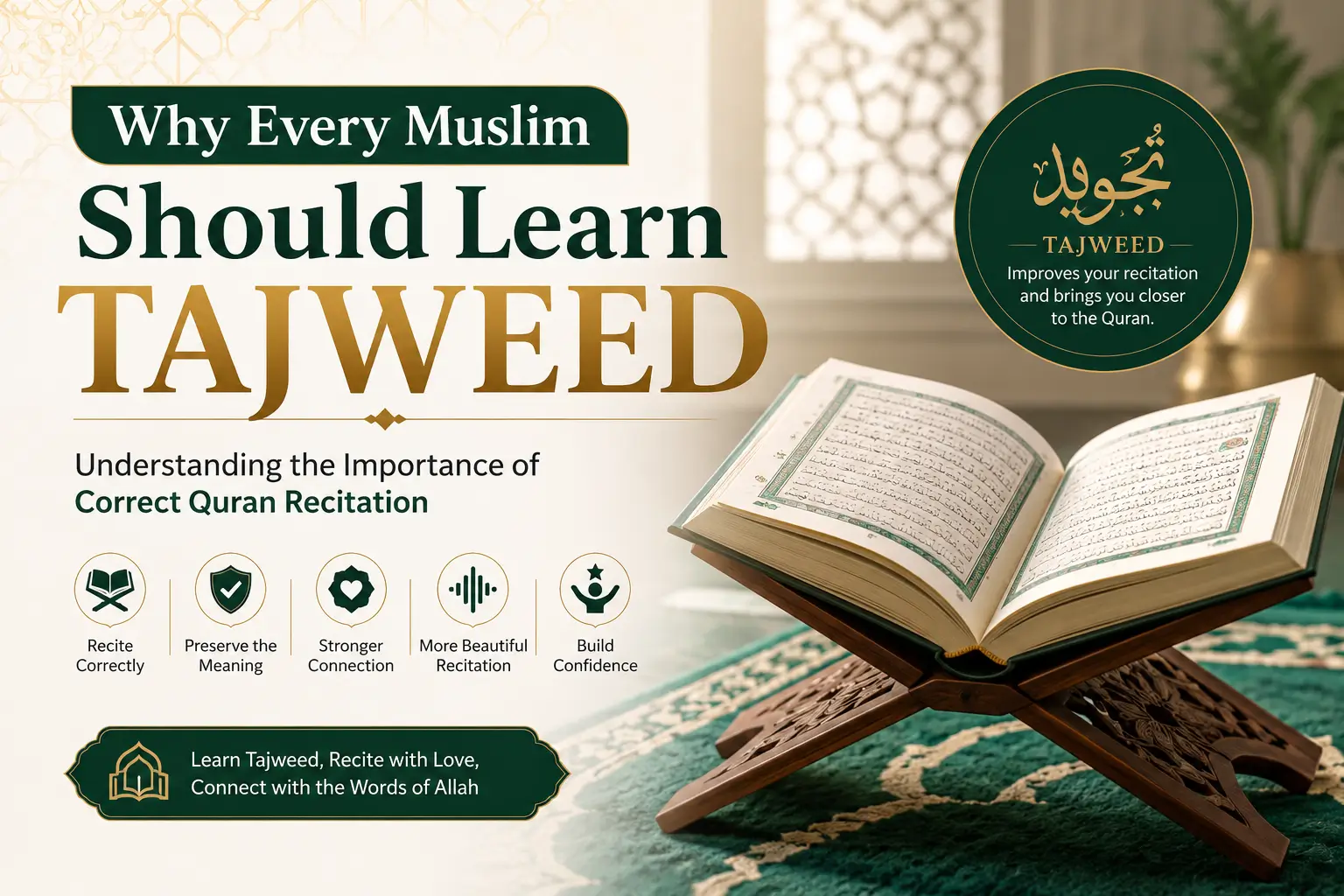

The Quran is the holy book of Islam and the ultimate source of guidance for Muslims around the world. Muslims recite the Quran to worship Allah, seek guidance, find peace, and strengthen their connection with their faith. However, reading the Quran is not only about recognizing Arabic letters and words. Correct pronunciation and proper recitation are also extremely important.
This is why every Muslim should learn Tajweed.
Tajweed is the set of rules that helps Muslims pronounce the letters and words of the Quran correctly while observing their proper characteristics and recitation rules. Learning Tajweed allows a person to recite the Quran more accurately, beautifully, and respectfully.
Whether someone is a beginner, a child, or an adult who has been reading the Quran for years, learning Tajweed can significantly improve their Quran recitation.
What Is Tajweed?
The word Tajweed means “to improve” or “to make better.” In Quranic recitation, Tajweed refers to the rules that explain how each Arabic letter should be pronounced and how Quranic words should be recited correctly.
These rules include:
- Correct pronunciation of Arabic letters
- Understanding the characteristics of each letter
- Proper use of elongation
- Correct stopping and starting points
- Rules related to Noon Sakinah and Tanween
- Rules related to Meem Sakinah
- Proper pronunciation of heavy and light letters
- Correct application of Ghunnah
Some Arabic letters have similar sounds, and even a small change in pronunciation can sometimes change the meaning of a word. Tajweed helps prevent these mistakes and enables Muslims to recite the Quran as accurately as possible.
Why Every Muslim Should Learn Tajweed
1. Tajweed Helps You Recite the Quran Correctly
One of the most important reasons to learn Tajweed is to improve the accuracy of Quran recitation.
The Quran was revealed in Arabic, and every letter has a specific pronunciation. If a letter is pronounced incorrectly, the meaning of a word may potentially change. Tajweed teaches learners how to pronounce letters from their correct points of articulation, known as Makharij al-Huruf.
For example, some Arabic letters may sound similar to learners who are not familiar with Arabic pronunciation. Tajweed provides the knowledge and practice needed to distinguish between these sounds.
Learning Tajweed therefore helps Muslims protect the accuracy of their recitation.
2. It Helps Preserve the Meaning of the Quran
The Quran is the exact word of Allah, and its words carry deep meaning. Correct pronunciation is important because changing the sound of a letter, vowel, or word can affect the meaning.
A person who reads the Quran without understanding basic Tajweed rules may unintentionally make mistakes during recitation. While many beginners naturally make errors while learning, studying Tajweed helps reduce these mistakes over time.
This is especially important for Muslims who want to recite the Quran with greater accuracy and confidence.
3. Tajweed Improves Your Connection With the Quran
Learning Tajweed is not simply a technical exercise. It can also help Muslims develop a deeper relationship with the Quran.
As learners become more comfortable with pronunciation, pauses, and recitation rules, they often feel more confident when reading the Quran. This confidence can encourage them to recite more regularly.
A person who once struggled to read a page may eventually be able to recite with greater fluency and focus. This can make Quran recitation a more meaningful part of daily life.
4. It Makes Quran Recitation More Beautiful
The Quran has a unique rhythm and style of recitation. Tajweed helps learners understand how to recite the words with proper pronunciation, elongation, pauses, and characteristics.
This does not mean that every learner needs to become a professional Qari. Instead, Tajweed allows ordinary Muslims to improve the quality and accuracy of their recitation.
When the rules are applied correctly, Quran recitation becomes more fluent, balanced, and beautiful.
5. Tajweed Builds Confidence in Quran Reading
Many Muslims feel nervous when reciting the Quran in front of others because they are worried about making mistakes. This is particularly common among beginners and people who did not have the opportunity to study Quran recitation properly during childhood.
Learning Tajweed step by step can help build confidence.
With regular practice and guidance from a qualified teacher, students can gradually improve their pronunciation and fluency. Over time, they may feel more comfortable reciting the Quran during personal worship, family gatherings, or prayer.
Why Children Should Learn Tajweed Early
Children can benefit greatly from learning Tajweed at an early age. Young learners are often able to develop correct pronunciation habits through regular practice.
When children learn the correct pronunciation of Arabic letters from the beginning, they may find it easier to build strong Quran reading skills later.
A structured Tajweed program can help children learn:
- Arabic letters and their sounds
- Basic Quran reading
- Correct pronunciation
- Quran recitation rules
- Proper stopping and continuation
- Fluency through regular practice
Parents can support their children’s learning by creating a positive and consistent Quran learning routine at home.
Is Tajweed Only for Advanced Quran Readers?
No. Tajweed is for everyone.
Some people believe they need to be advanced Quran readers before learning Tajweed. In reality, beginners can start learning basic Tajweed from the very beginning.
A student may begin with:
- Learning the Arabic alphabet
- Understanding the correct pronunciation of letters
- Practicing short vowels
- Learning basic reading rules
- Studying essential Tajweed principles
- Applying those rules while reading Quranic verses
More advanced students can continue studying detailed rules of recitation and improve their fluency over time.
The most important thing is to learn gradually and practice consistently.
Common Quran Recitation Mistakes Tajweed Can Help Correct
Many Quran readers make mistakes without realizing it. Some common mistakes include:
- Mispronouncing Arabic letters
- Confusing letters with similar sounds
- Ignoring proper elongation
- Stopping at an inappropriate place
- Failing to apply rules of Ghunnah
- Reading heavy letters as light letters
- Reading light letters too heavily
- Rushing through verses
These mistakes are usually not intentional. Many Muslims simply have not had access to a qualified Quran teacher.
Studying Tajweed can help identify and correct these issues through explanation, repetition, and guided practice.
Learning Tajweed Online: A Convenient Option for Muslims Worldwide
Today, Muslims living in different parts of the world can learn Quran and Tajweed online. Online Quran classes can be especially useful for people who have busy schedules, live far from Islamic learning centers, or prefer learning from home.
Online learning can offer:
- Flexible class schedules
- One-on-one instruction
- Personalized feedback
- Learning from home
- Access to qualified Quran teachers
- Programs for children and adults
For Muslims looking for structured online Quran and Tajweed lessons, International Quran Academy provides an opportunity to learn with qualified instructors from the comfort of home.
A suitable learning program can help students progress according to their current level, whether they are complete beginners or already familiar with Quran reading.
How to Learn Tajweed Effectively
Learning Tajweed requires patience and regular practice. Here are some useful steps:
Start With the Basics
Do not try to memorize every Tajweed rule at once. Begin with the basic pronunciation of Arabic letters and gradually move toward more advanced rules.
Learn From a Qualified Teacher
Books and videos can be helpful, but a qualified teacher can listen to your recitation and identify mistakes that you may not notice yourself.
Practice Regularly
Even a short daily practice session can be more effective than studying Tajweed only occasionally. Consistency is the key to improvement.
Listen to Skilled Quran Reciters
Listening to experienced reciters can help learners become familiar with correct pronunciation, rhythm, pauses, and recitation patterns.
Read Slowly
Beginners should focus on accuracy rather than speed. Reading slowly allows learners to concentrate on each letter and rule.
Be Patient With Yourself
Learning Tajweed takes time. Mistakes are a natural part of the learning process. With regular practice and proper guidance, improvement becomes easier.
The Spiritual Importance of Learning Tajweed
For Muslims, learning Tajweed is not only about improving pronunciation. It is also an act of respect toward the Quran.
The Quran deserves to be recited with care and attention. Learning how to pronounce its words correctly shows a person’s desire to improve their worship and recitation.
Many Muslims also find that learning Tajweed helps them slow down and focus during Quran recitation. Instead of rushing through the words, they become more aware of what they are reading.
This can help create a more meaningful and focused Quran-reading experience.
Can Adults Learn Tajweed?
Absolutely.
It is never too late to learn Tajweed. Many adults begin studying Quran recitation after years of reading without formal instruction.
Adult learners may want to improve their pronunciation, correct long-standing mistakes, or develop greater confidence in reciting the Quran.
A flexible online learning program can be particularly helpful for adults because lessons can often be arranged around work, family, and other responsibilities.
The important thing is to begin.
How Long Does It Take to Learn Tajweed?
The time required to learn Tajweed varies from person to person. It depends on factors such as:
- The learner’s current Quran reading ability
- Familiarity with Arabic letters
- Practice frequency
- The number of Tajweed rules being studied
- Guidance from a qualified teacher
Some students may learn basic rules within a relatively short period, while others may need more time and practice.
Tajweed is not a race. The goal is to improve accuracy and develop a strong foundation that can be used throughout a person’s Quran reading journey.
Final Thoughts: Why Every Muslim Should Learn Tajweed
So, why should every Muslim learn Tajweed?
Because the Quran deserves to be recited with accuracy, care, and respect.
Tajweed helps Muslims pronounce Arabic letters correctly, reduce recitation mistakes, improve fluency, build confidence, and develop a stronger connection with the Quran. It is beneficial for children, adults, beginners, and experienced Quran readers alike.
With the availability of online Quran learning, studying Tajweed has become more accessible to Muslims around the world. Through consistent practice and guidance from qualified teachers, anyone can gradually improve their Quran recitation.
For those looking for structured online Quran and Tajweed learning, International Quran Academy can be a convenient option for students and families seeking to learn from home.
The journey of learning Tajweed may require patience, but every step toward improving Quran recitation is a valuable step toward strengthening one’s connection with the Book of Allah.